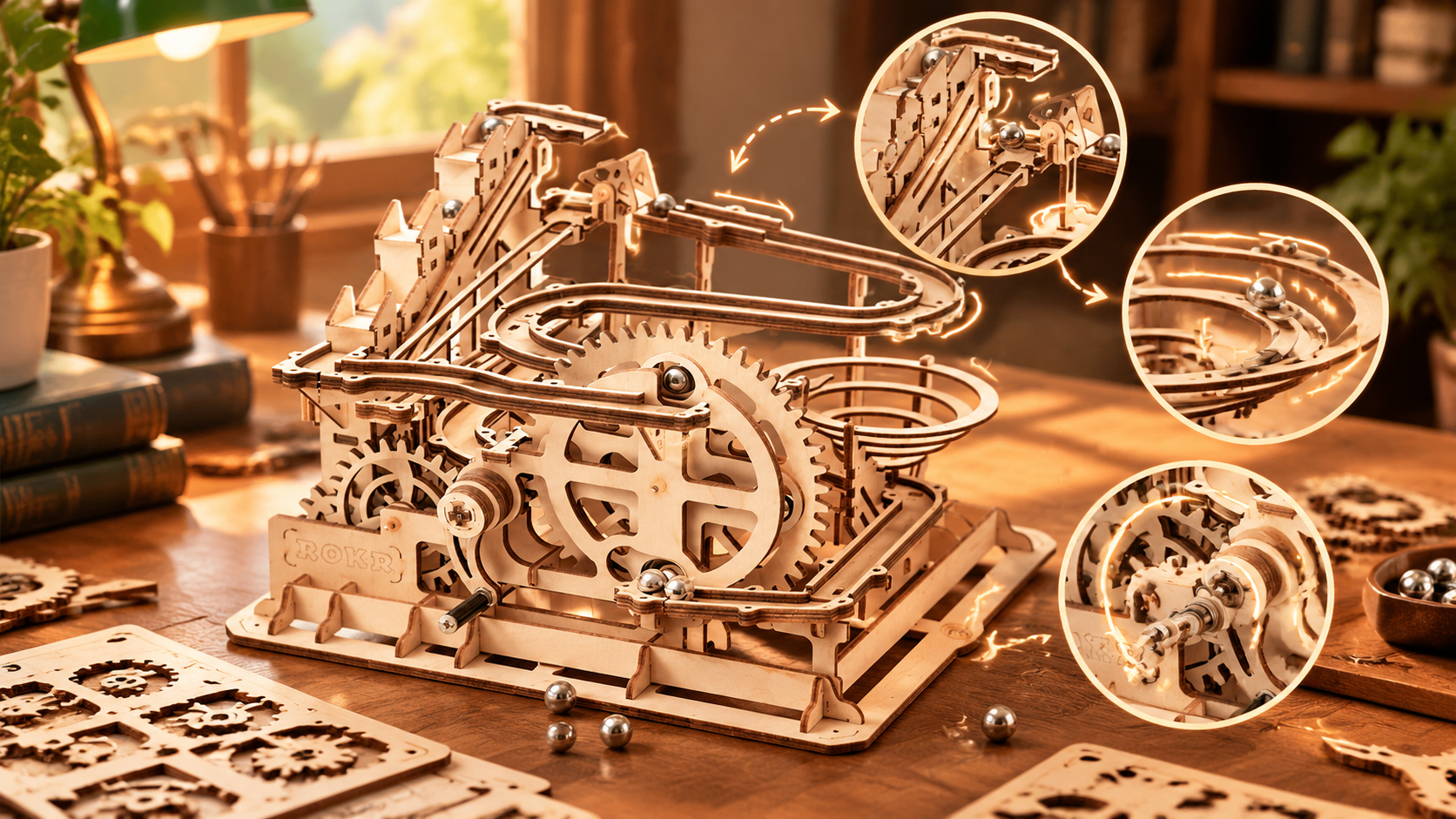

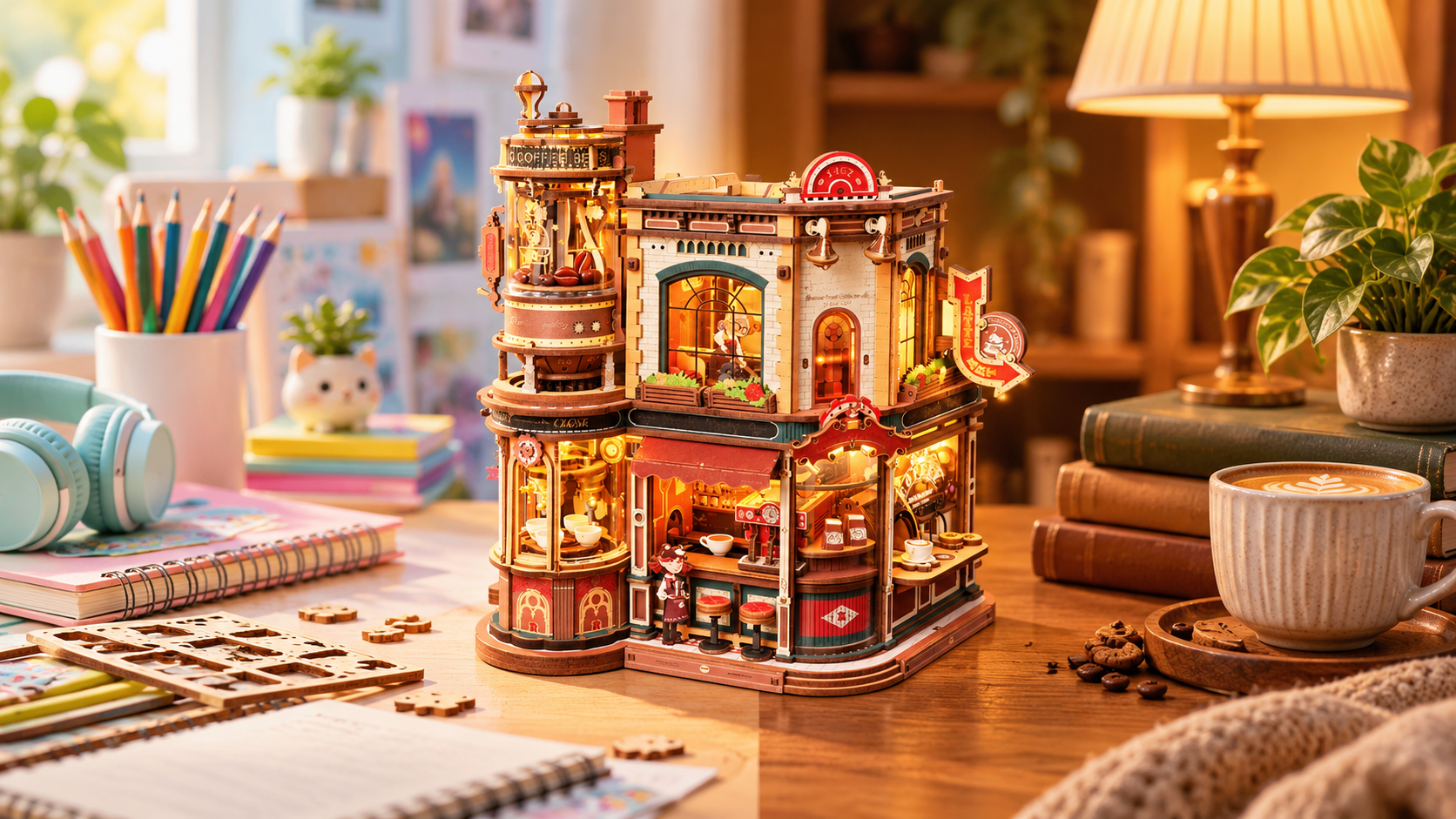
Adult and teen model kits are not always different kinds of products. The same 14+ model may appeal to a teenager building a first mechanism and an adult looking for an evening project. The more useful question is how to read the information on the box: recommended age, product-specific safety guidance, difficulty, build time, and the builder’s experience.
Start with the 14+ label. Then decide whether the challenge inside the box is a good fit.
What Does 14+ Mean on a Model Kit?
A 14+ mark is the maker’s recommended minimum age for that specific kit. It does not promise that every 14-year-old will enjoy the build, and it does not reserve the kit for teens. Adults can build it too. Always check the current product page, packaging, instructions, and any safety notices before choosing it for someone.
Why might a model carry that recommendation? Depending on the kit, relevant considerations can include small or delicate parts, the hand control needed to fit them, tools or accessories, moving mechanisms, careful alignment, and the patience required to follow a long sequence. Some models may have additional product-specific handling or safety guidance. The number “14+” by itself does not tell you which consideration applies to a particular model.
A builder’s account makes the handling issue concrete. In the first stage of Chillbay Pizzeria, Gidge connected the motor, lights, and sound, then wrote, “One tiny piece went flying,” after a small part slipped from tweezers. That experience cannot explain every kit’s age mark, but it shows why the actual parts and instructions deserve a closer look.
In the United States, the Consumer Product Safety Commission defines a children’s product as one designed or intended primarily for children 12 or younger. A maker’s age statement is one factor in that assessment, alongside how the product is presented and used. A 14+ label is therefore not a CPSC rule by itself, nor does it automatically establish a product’s regulatory classification.
Does 14+ Describe Safety, Difficulty, or Both?
Age recommendation and assembly difficulty are related, but they are not the same measurement. Age guidance addresses the intended builder and the kit’s overall suitability, including any handling and safety considerations. Difficulty describes the work of putting the model together.
That distinction matters when shopping. One 14+ kit might have a short, approachable assembly. Another 14+ kit might require many sessions, precise fits, and testing a mechanism as it takes shape. Both can carry the same minimum age while offering very different building experiences. Read the age label first; use the difficulty information to decide what kind of challenge the builder wants.
The confusion is familiar even to experienced adults. Discussing a Rowood flower kit, Nita_Davis wrote, “They say for kids 14+.” She then joked that the builds could still be tough for her at 62. Her comment concerns that flower kit; it illustrates why meeting a recommended age does not promise an easy assembly.
Recommended Age ≠ Assembly Difficulty
| Question | Recommended age | Assembly difficulty |
|---|---|---|
| What does it answer? | Who is this kit recommended for? | How demanding is the build? |
| What might you see? | 14+ | Beginner, Intermediate, or Advanced; on ROKR pages, often Easy, Medium, or Difficult |
| What should you check? | The package age mark and product-specific safety and handling guidance | Steps, precision, mechanisms, estimated time, and the builder’s experience |
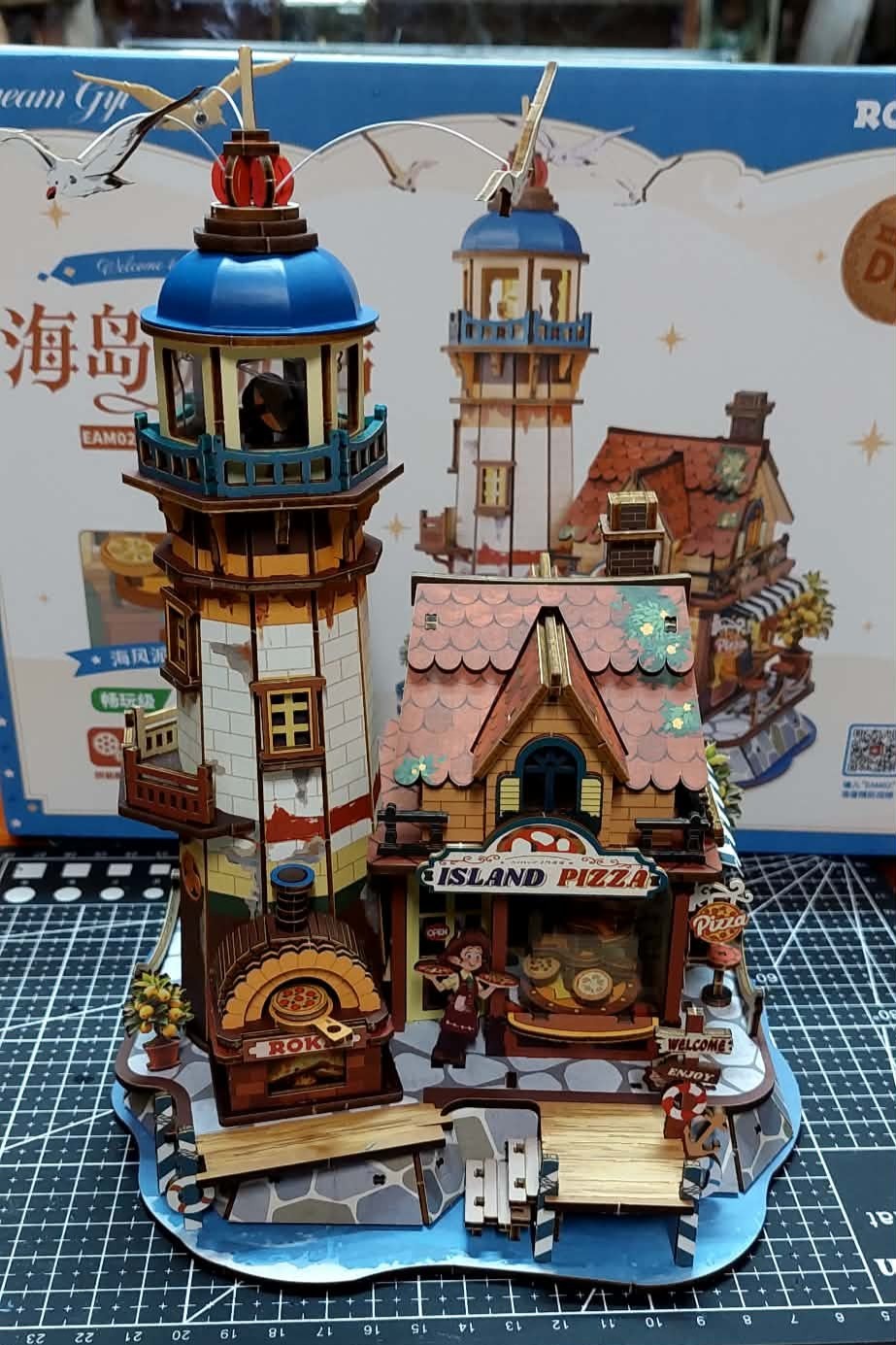
For a concrete example, ROKR lists the Morse Telegraph CGM02 as 14+ with a two-star difficulty rating. The Chillbay Pizzeria EAM02 is also 14+, but its difficulty is listed as high or advanced. The shared age recommendation does not make their assembly challenges the same.
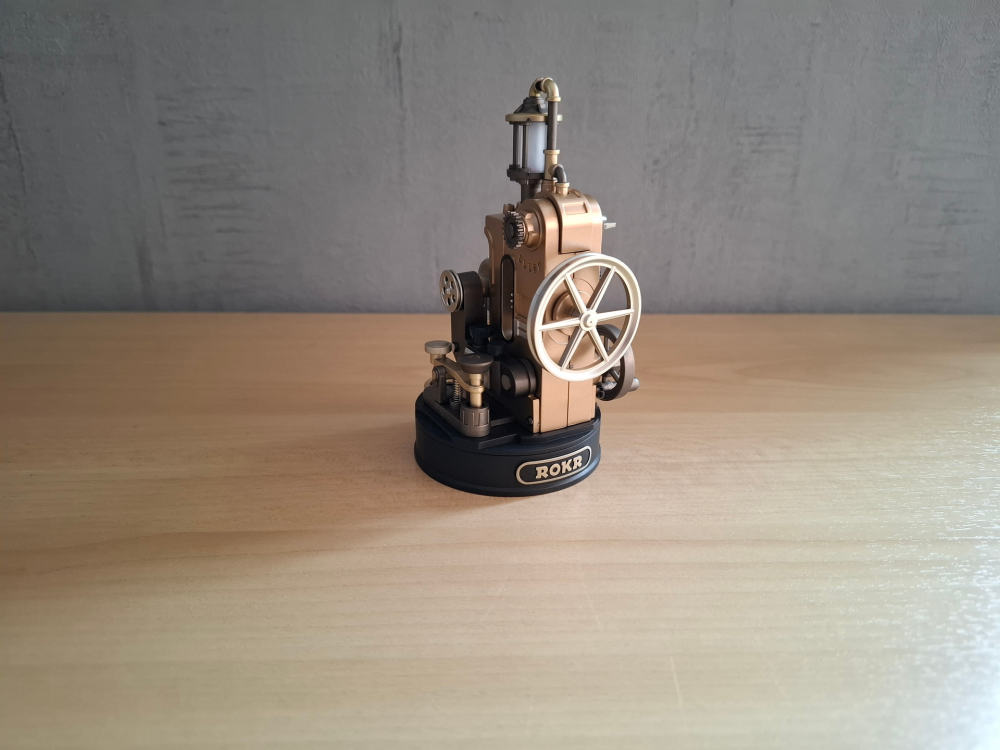
These are individual build impressions, not replacements for the published difficulty ratings. They show why the same label can feel different once a particular builder starts working.
Why Are So Many ROKR Model Kits Recommended for Ages 14+?
Many ROKR mechanical models bring together precisely fitted pieces, gears, linkages, or other moving structures. They can ask the builder to align parts carefully, follow illustrated steps over several sessions, and check how a mechanism works before moving on. These characteristics help explain why many models carry a 14+ recommendation.
The label should still be read on the individual kit. ROKR covers more than one style of build, and an age mark does not reveal the full difficulty or every handling instruction. A 14+ recommendation should not be treated as an invitation to give the kit to a younger builder simply because an adult can help.
Beginner, Intermediate, and Advanced: Which Should You Choose?
Once the kit’s recommended age fits the builder, choose the challenge. ROKR commonly uses Easy, Medium, and Difficult on its site; Beginner, Intermediate, and Advanced are useful plain-language ways to think about those levels.
Beginner / Easy
Choose a beginner build if this is a first model, the builder wants a shorter project, or the goal is to practice reading instructions and fitting parts without a dense mechanism. A beginner rating describes the assembly, not the builder’s age.
Intermediate / Medium
An intermediate build can suit someone who has completed a model and wants more steps, more detailed alignment, or a more involved moving structure. Compare the estimated time and the kind of mechanism rather than relying on the level name alone.
Experience can transfer across model styles, though the next build may introduce new demands. Before starting a first moving ROKR model, Tilt-A-Whirl, Kycso had built static miniatures, watched tutorials, and said, “I tested every step carefully.”
Advanced / Difficult
An advanced build is for someone who wants a longer, more precise challenge. Complex mechanisms, repeated checking, and possible wiring or linkage work can be part of a particular kit; read its product details to see what is actually involved.
A first model can be ambitious if the builder is prepared for the work. TheToday chose the Seahorse Barque after reading that it was “quite a complicated one,” then spread the assembly over short sessions. Their account also describes breaking two delicate pieces. It is a useful example of how patience and handling affect a demanding build.
Can a Teen Build an Advanced 14+ Model?
Possibly, but the two labels answer different questions. “14+” gives the recommended age range; “Advanced” signals the expected building challenge. A teen who meets the age recommendation and already enjoys long, precise projects may welcome that challenge. A first-time builder may have a better experience starting with a shorter kit.
Look at previous model-building experience, willingness to follow the manual, available time, and any tools or mechanisms involved. Read the particular kit’s instructions and safety guidance. Supervision can support an age-appropriate build, but it does not cancel the age recommendation on the package.
One teen builder described the mix of enjoyment and effort herself. In a post shared by her parent, 15-year-old Olivia called her Marble Climber project “really fun but difficult at the same time” and described tiny sleeve shafts and a step she had to redo. Her experience shows what to ask about a particular build; it does not establish that every advanced kit suits every teen.
Can an Adult Start With a Beginner Model?
Absolutely. Beginner does not mean “for children.” It means the assembly is more approachable. An adult may want a first project to learn the fitting process, a compact build for a free evening, or simply a design they would like to display. Difficulty is a choice about the experience, not a test of the builder’s maturity.
Beginner also need not mean visually or mechanically plain. Describing the small ROKR Vegas Never Sleeps kit, Kim_Kieffer wrote, “What impressed me most is how much detail and function they packed into such a small beginner kit.” The finished model has moving wheels. The level describes a way into the hobby, not an age group.
Choose by Age, Then by Challenge
When comparing model kits for adults and teens, start with the individual product’s age and safety information. Then use difficulty, build time, mechanisms, and the builder’s experience to narrow the choice. The same 14+ kit may work for both age groups, while two 14+ kits may feel entirely different on the worktable. If you need suggestions organized by life stage, ROKR’s age-based model kit guide covers that separate question.