Some astronomical events are difficult to understand not because their results are invisible, but because we cannot see the complete system of motion behind them.
A solar eclipse may look like a dark circle passing across the Sun. What determines that moment, however, is the changing position and timing of the Sun, Moon, and Earth. A meteor shower presents a different kind of motion: Earth crosses a stream of small particles left along a comet’s orbit.
Both events will draw attention to the sky in August 2026. On August 12, a total solar eclipse will cross parts of the Northern Hemisphere. That night and into the early hours of August 13, the Perseid meteor shower will reach its expected peak under a new Moon.
The two events are not physically connected. Their timing simply gives skywatchers an unusual opportunity to observe two different results of celestial motion within the same day.
This guide explains where the eclipse will be visible, how to observe it safely, what causes the Perseids, and how physical activities can help make motion, alignment, and location easier to examine at home.
August Skywatching 2026: Quick Event Guide
| Event | Key date | What happens | How to observe |
|---|---|---|---|
| Total and partial solar eclipse | August 12, 2026 | The Moon passes between Earth and the Sun, casting a shadow across part of Earth | Use safe solar-viewing protection during every partial phase |
| Perseid meteor shower peak | Night of August 12–13, 2026 | Earth passes through particles left by Comet 109P/Swift-Tuttle | Find a dark location and watch a wide area of sky with the unaided eye |
Check the current NASA eclipse map and a local weather forecast before making plans. Eclipse coverage, event times, cloud conditions, and the position of the Sun vary by location.
August 12, 2026 Solar Eclipse: Where Will It Be Visible?
On August 12, 2026, the path of totality will cross Greenland, Iceland, a remote part of northern Russia, the North Atlantic, Spain, and a small corner of Portugal.
Inside this narrow path, the Moon will completely cover the Sun for a brief period. For most places in the path, totality will last less than two minutes. Observers nearer the center line in Greenland, northern Russia, or the North Atlantic may experience a slightly longer total phase, though still less than two and a half minutes.
A much larger area will see a partial solar eclipse. According to NASA, this includes most of Canada, much of Europe, northwestern Africa, and parts of the northern United States.
Coverage will differ considerably from one location to another. London, Paris, Dublin, Madrid, New York, and Detroit will all experience different percentages and local times. The path of totality will not cross the continental United States.
For many observers in mainland Europe and northwestern Africa, the eclipse will occur in the evening. In some cities, the Sun will set before the partial phase has ended. A clear western horizon will therefore matter almost as much as the weather.
This geographic variation is an important part of eclipse science. The celestial event is global, but every observation is made from one specific point on Earth.
How to View the Solar Eclipse Safely
Except during the brief total phase seen from inside the path of totality, it is unsafe to look directly at the Sun without proper eye protection.
Use eclipse glasses or a handheld solar viewer that complies with the ISO 12312-2 international safety standard. Ordinary sunglasses are not safe, regardless of how dark they appear.
Inspect solar viewers before use. Discard them if the lenses are scratched, torn, punctured, or separated from the frame. Children should use solar viewers only with adult supervision.
Do not look at the Sun through a camera lens, telescope, binoculars, or another optical device while wearing eclipse glasses. These instruments concentrate sunlight and can damage both the filter and your eyes. Optical equipment requires a purpose-built solar filter attached securely to its Sun-facing end.
Only observers inside the path of totality may remove eye protection, and only after the Moon has completely covered the Sun’s bright face. Eye protection must be replaced as soon as any bright part of the Sun reappears.
If you do not have a safe solar viewer, use an indirect method such as a pinhole projector. Stand with the Sun behind you and observe the projected image on another surface. Never look at the Sun through the pinhole.
Review NASA’s complete eclipse viewing safety guidance before observing.
How Does a Solar Eclipse Work?
A solar eclipse occurs when the Moon passes between Earth and the Sun and casts a shadow on part of Earth.
The darkest central part of the Moon’s shadow is called the umbra. Observers reached by the umbra can experience a total solar eclipse. The wider and lighter part of the shadow is the penumbra, where the Sun appears only partially covered.
Because the Moon’s shadow reaches a limited area of Earth, the same eclipse can appear total from one location, partial from another, and completely invisible from somewhere else.
Why Does a Solar Eclipse Not Happen Every Month?
A solar eclipse can occur only around a new Moon, when the Moon is on the Sun-facing side of Earth. A new Moon happens about once a month, but the three bodies do not line up closely enough for an eclipse every time.
The Moon’s orbit is tilted by about five degrees relative to the plane of Earth’s orbit around the Sun. During most new Moons, the Moon appears to pass slightly above or below the Sun from our viewpoint, so its shadow misses Earth.
Eclipses become possible only when a new Moon occurs close to one of the points where the Moon’s orbital plane crosses the Earth–Sun plane.
The orbital paths shown in diagrams are not physical rails in space. They are simplified ways of representing motion governed by gravity. Because these movements follow measurable patterns, astronomers can calculate when and where future eclipses will occur.
Why Physical Models Help Us Understand the Sky
A flat diagram can show where objects are located at one moment. It is less effective at showing how several positions continue to change at different rates.
An animation can show that movement, but the viewer usually follows a speed and viewpoint selected by someone else. The sequence continues whether or not a particular relationship has been understood.
A physical model offers another way to examine the same idea. The person operating it can control the pace, stop at a chosen position, repeat a short sequence, and observe how one movement reaches another part of the system.
This hands-on control does not automatically make a model more scientifically accurate. A useful model always simplifies reality. Its value comes from making selected relationships easier to isolate and discuss.
For astronomy, those relationships may include:
- Repeated movement: observing what returns and what changes during each cycle.
- Relative position: comparing where one body appears in relation to another.
- Temporary alignment: noticing when moving objects briefly share a line of sight.
- Different rates of motion: comparing parts that do not complete a cycle together.
- Mechanical cause and effect: tracing how one input reaches several connected parts.
A model should therefore be treated as a thinking tool. It does not replace observation, measurement, or astronomical calculation. It gives difficult-to-see relationships a physical form that can be slowed down and examined.
Why ROKR Created a Mechanical Solar System Model
For centuries, people have built physical models to give visible form to celestial systems that are otherwise too large, distant, and slow to observe as a whole. ROKR drew on this history when developing the Mechanical Orrery ST001.
The intention was not to reproduce the solar system at its true scale. It was to translate planetary movement into a mechanical system that people could assemble, operate, and examine.
ST001 uses a multi-layer gear train to create a multi-stage transmission. Turning one hand crank drives eight planets along nine stacked orbital tracks at different speeds. Several positions change at the same time, making one central idea easier to observe: the solar system is not a fixed arrangement of objects. It is a continuously moving system in which each body follows its own path.
The building process exposes how that movement is produced. Gears, supports, orbital tracks, and transmission components begin as separate parts. Once assembled, they transform one manual input into several coordinated motions.
This is where operating a mechanism differs from watching a finished animation. The person turning the crank controls the pace. The motion can be slowed, paused at a particular position, and repeated while the transmission is examined at close range.
The hand crank produces another visible result. As the mechanism turns, a built-in three-phase brushless motor uses electromagnetic induction to generate electricity for the illuminated Sun. This introduces another cause-and-effect relationship: manual movement drives the mechanical transmission, and part of that input is converted into electrical energy and light.
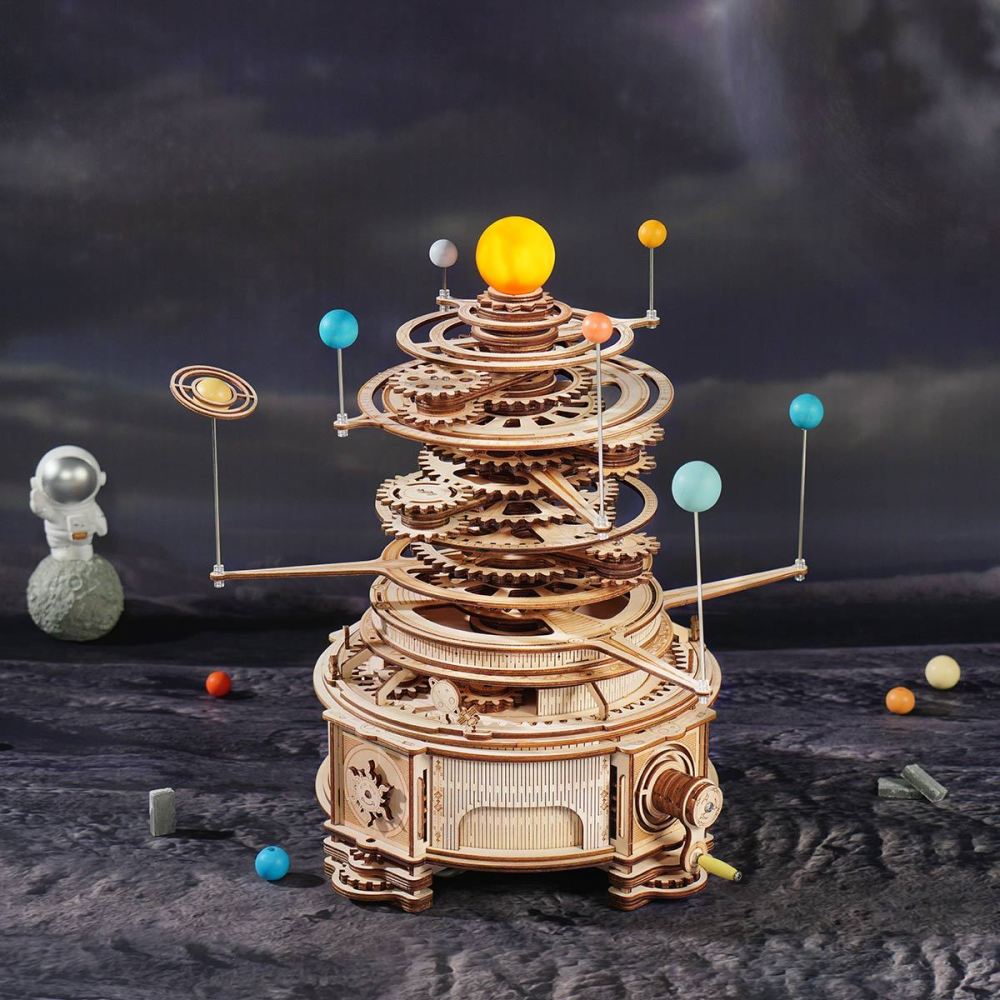
ST001 is both a construction project and a simplified mechanical interpretation of planetary movement. It does not reproduce real orbital distances, speeds, or planetary positions with astronomical precision, and it cannot calculate eclipse dates. Its role is to give repeated motion, relative position, gear transmission, and energy conversion a physical form that can be operated and examined.
What to Observe While the Model Is Moving
Instead of turning the crank only to watch the finished model operate, begin with a question:
- Compare speed: Which orbital tracks move through a visible section more quickly?
- Trace transmission: How does one crank input reach several orbital layers?
- Track position: How do the relative positions of two planets change as the motion continues?
- Look for alignment: At what point do two or more bodies appear aligned from your viewing position?
- Follow energy: How does the illuminated Sun connect mechanical input with electrical output?
The model becomes more useful when movement leads to observation, comparison, and another question.
What Causes the Perseid Meteor Shower?
A meteor is not a falling star. Most meteors begin as small pieces of rock or dust called meteoroids.
Comet 109P/Swift-Tuttle leaves particles along its orbit as it travels around the Sun. Every year, Earth crosses part of this debris stream. When the particles enter Earth’s atmosphere at high speed, they compress and heat the surrounding air, producing the short streaks of light we call meteors.
The Perseids take their name from the constellation Perseus. If their paths are traced backward across the sky, they appear to meet near a point in that constellation. This apparent point of origin is called the radiant.
The meteors are not physically coming from Perseus. The radiant is an effect of perspective, similar to the way parallel railway tracks appear to meet in the distance.
You also do not need to look directly at Perseus. Meteors can appear across a wide area of sky, and those farther from the radiant may produce longer visible trails.
Why the 2026 Perseids Are Worth Watching
The Perseids are active from approximately July 17 through August 24. The American Meteor Society lists the expected 2026 peak for the night of August 12–13.
The Moon will be new on August 12, so moonlight should create very little interference. That gives fainter meteors a better chance of remaining visible from a dark location.
Under rural conditions near the maximum, the American Meteor Society notes that observers may commonly see around 30 to 50 Perseid meteors per hour. This is not a guarantee. Actual results depend on cloud cover, artificial light, haze, viewing time, latitude, nearby obstructions, and how much of the sky is visible.
Someone watching from an open rural location may see far more meteors than someone observing between brightly lit city buildings. Even under a clear sky, activity may arrive unevenly, with several quiet minutes followed by multiple meteors in a short period.
How to Watch the 2026 Perseids
- Find darker surroundings: Move away from bright streetlights, buildings, and vehicle headlights.
- Keep the view open: Choose a safe place with as much visible sky as possible.
- Allow time to adapt: Give your eyes 20 to 30 minutes in darkness.
- Protect night vision: Avoid checking bright phone screens while observing.
- Watch a broad area: Do not stare only at Perseus or the radiant.
- Stay later when possible: The final dark hours before dawn are often favorable.
- Prepare for the setting: Bring a reclining chair or blanket and a light outer layer.
- Check conditions: Review the weather, cloud forecast, and local safety conditions before leaving.
A telescope is not needed for the Perseids. Its narrow field of view covers too little sky. The unaided eye is more useful because it can monitor a much wider area at once.
Four Hands-On Astronomy Activities at Home
Real skywatching depends on geography and weather. These activities provide another way to explore the same relationships if the eclipse is not visible locally or clouds interrupt the Perseids.
1. Recreate a Solar Eclipse
Use an LED lamp as the Sun, a small ball as the Moon, and a globe or larger ball as Earth.
Darken the room and move the small ball between the lamp and Earth. Observe the shadow cast on Earth as the distance and angle change.
Sometimes the darkest part of the shadow will reach only a small area. At other positions, the lighter outer shadow will cover a wider region. A small change in alignment may cause the shadow to miss Earth completely.
This demonstrates why totality follows a narrow path and why observers outside that path see a partial eclipse or no eclipse at all.
2. Pause the Motion and Predict the Alignment
Use ST001 to investigate changing relative positions, or create a simpler moving model with balls and orbital rings.
Choose two moving bodies and record their starting positions. Before moving the model, predict how their positions will change relative to each other.
Turn the mechanism slowly. Pause when the bodies appear close to an alignment and compare the observed position with the prediction. Continue moving and notice how quickly the alignment disappears.
Repeat the activity from a different starting point. Try changing the operating speed without changing the sequence of movement.
- Observe the starting position.
- Make a prediction.
- Move the model.
- Pause at a chosen point.
- Compare the result.
- Revise the prediction.
This sequence helps show that alignment is temporary. The objects continue moving, and a relationship seen at one moment changes as soon as the system advances.
3. Trace the Eclipse Path on a Globe
Open NASA’s August 12 eclipse map and locate Greenland, Iceland, northern Spain, Portugal, and the nearby parts of Europe and northwestern Africa.
Compare the narrow path of totality with the much larger area that will experience a partial eclipse. Then locate your own position and consider why the event will look different there.
The ROKR Luminous Globe ST003 provides a physical reference for this activity. Its map can be turned beneath a movable magnifier, making it easier to locate countries and follow the eclipse path from one region to another.

The globe does not contain a built-in eclipse map. Use it alongside NASA’s current path information. Its role is to support the geographic question: where is the observer in relation to the Moon’s moving shadow?
4. Keep a Meteor Observation Log
A notebook can turn a casual evening outside into a simple observation project.
Record:
- Time and place: the date, location, and observation start and end times.
- Sky conditions: cloud cover, haze, and nearby sources of artificial light.
- Viewing setup: the direction you faced and how much of the sky was visible.
- Intervals: the number of meteors seen during each 15-minute period.
- Notable details: unusually bright meteors, visible colors, or persistent trails.
Do not set a required meteor count. The purpose is to notice how conditions and viewing time affect the result.
If several people are observing, ask each person to watch a different part of the sky. Compare the logs afterward. Differences may reveal how viewing direction, attention, and obstructions influence what each observer records.
Choose a Model by the Question You Want to Explore
Different models support different kinds of inquiry. They should not all be described as interchangeable astronomy models.
| Question | Hands-on model | What it helps you examine |
|---|---|---|
| How can one manual input produce several coordinated motions? | Mechanical Orrery ST001 | Nine stacked orbital tracks, changing relative positions, gear transmission, temporary alignment, and hand-powered illumination |
| Why does the same eclipse look different from different places? | Luminous Globe ST003 | Geography, observer location, and the relationship between total and partial-eclipse regions |
| How do people coordinate mechanical systems for space exploration? | Space Shuttle LKA02 | Launch structures, moving gears, robotic arms, lighting, and the transition from observing space to engineering for it |
ST001 focuses on repeated motion and mechanical transmission. ST003 changes the viewpoint from the solar system to Earth’s surface, where the observer’s location determines what can be seen.
The ROKR Space Shuttle LKA02 answers a different question. Its shuttle, launch structure, moving gears, robotic arms, and light effects shift the discussion from naturally occurring celestial motion to human engineering.
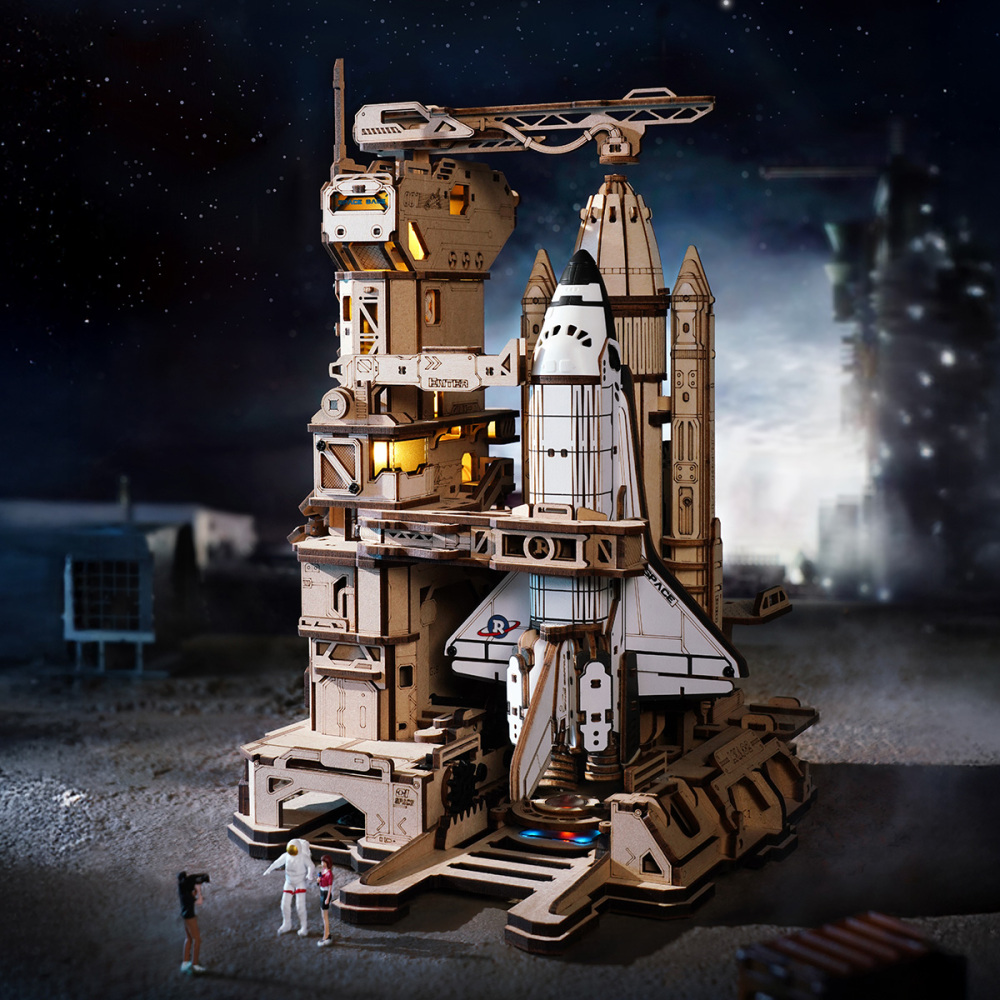
It does not explain the cause of an eclipse or meteor shower. Instead, it provides a physical scene for examining how multiple mechanical elements must work together before a spacecraft can leave the ground.
August 2026 Skywatching FAQ
Will the August 12, 2026 solar eclipse be visible in the United States?
Yes, but only as a partial eclipse. Parts of the northern United States will see a portion of the Sun covered, while the path of totality will not cross the continental United States. Check NASA’s current eclipse map for local coverage and times.
Where will the 2026 solar eclipse be total?
The path of totality will cross parts of Greenland, Iceland, northern Russia, the North Atlantic, Spain, and a small corner of Portugal. Totality is visible only inside this narrow path.
Why does a solar eclipse not happen every month?
The Moon’s orbit is tilted by about five degrees relative to Earth’s orbit around the Sun. During most new Moons, the Moon passes above or below the alignment needed for its shadow to reach Earth.
When is the best time to watch the 2026 Perseids?
The expected peak is the night of August 12–13. For many Northern Hemisphere observers, the hours after midnight and before dawn offer favorable viewing because the radiant climbs higher in the sky. Local darkness and weather remain important.
Do I need a telescope to watch the Perseids?
No. A telescope covers too little sky for meteor-shower viewing. Find a dark location and use your unaided eyes to watch a broad area overhead.
Can the Mechanical Orrery ST001 predict a real solar eclipse?
No. ST001 is a simplified mechanical interpretation of planetary movement, not a scale-accurate astronomical simulator or forecasting instrument. Real eclipse dates, paths, and local visibility should be checked through current astronomical data and authoritative eclipse maps.
What is the difference between ST001, ST003, and LKA02?
ST001 helps users examine repeated motion, relative position, gear transmission, and energy conversion. ST003 provides a geographic reference for comparing observer locations. LKA02 shifts the subject toward launch systems and human space engineering.
Observe, Record, and Ask a Better Question
Looking upward begins with observation. Understanding often requires us to slow movement down, repeat it, compare positions, or give an invisible relationship a physical form.
That is the role the ROKR models play in this guide. ST001 turns one hand-crank input into several coordinated orbital motions and an illuminated Sun. The Luminous Globe provides a physical reference for comparing locations on Earth. The Space Shuttle moves the question from observing space to examining the machines people build to explore it.
None of these models replaces the real sky or the scientific tools used to study it. They offer different ways to operate a system, examine its parts, and ask more precise questions about what we observe.
Check what will be visible from your location, prepare the correct safety equipment, record what you see, and try one of the physical activities before or after the event.
More projects connecting mechanical construction with astronomy, geography, optics, and engineering can be found in the ROKR Curious Discovery collection.