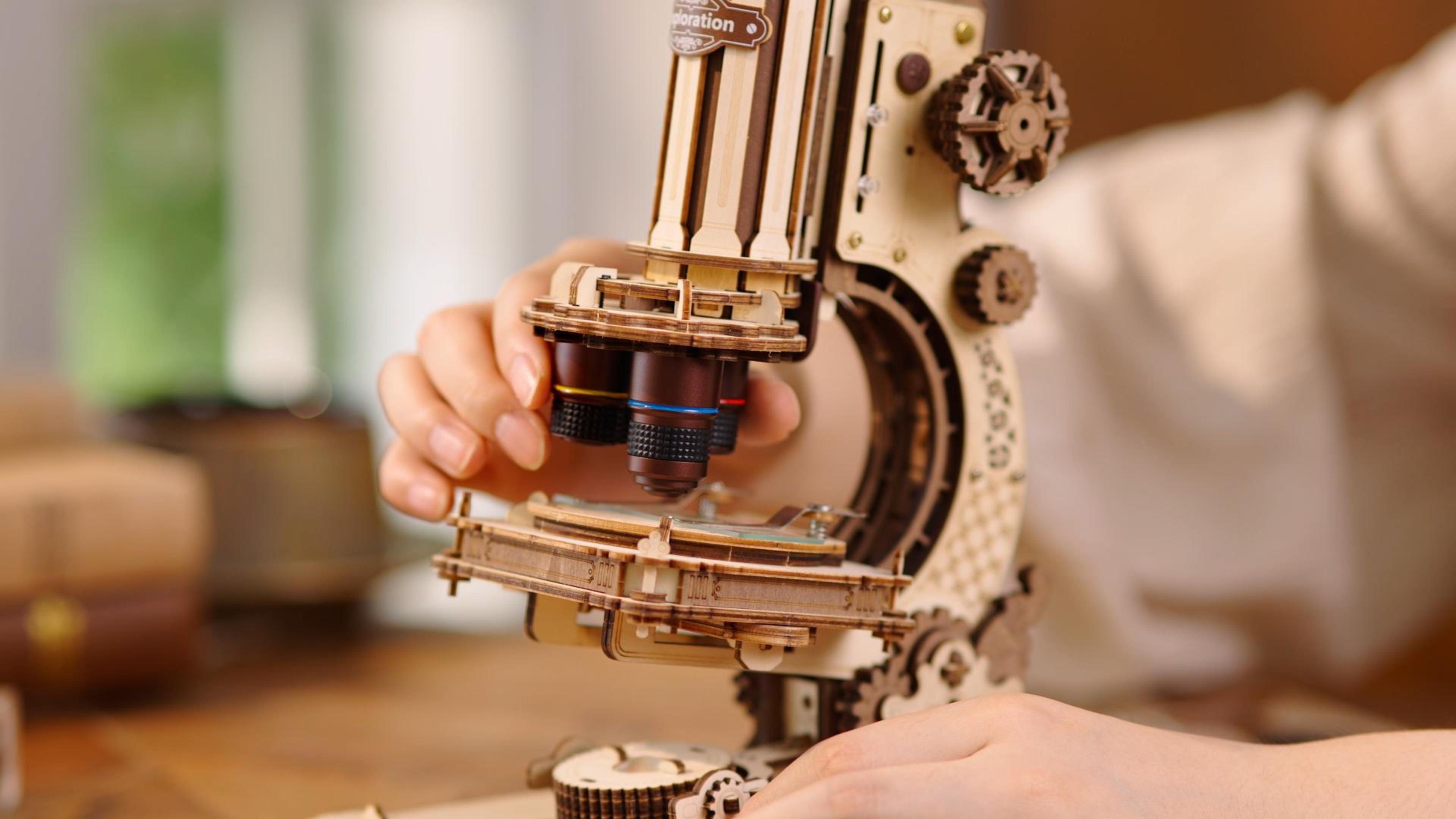
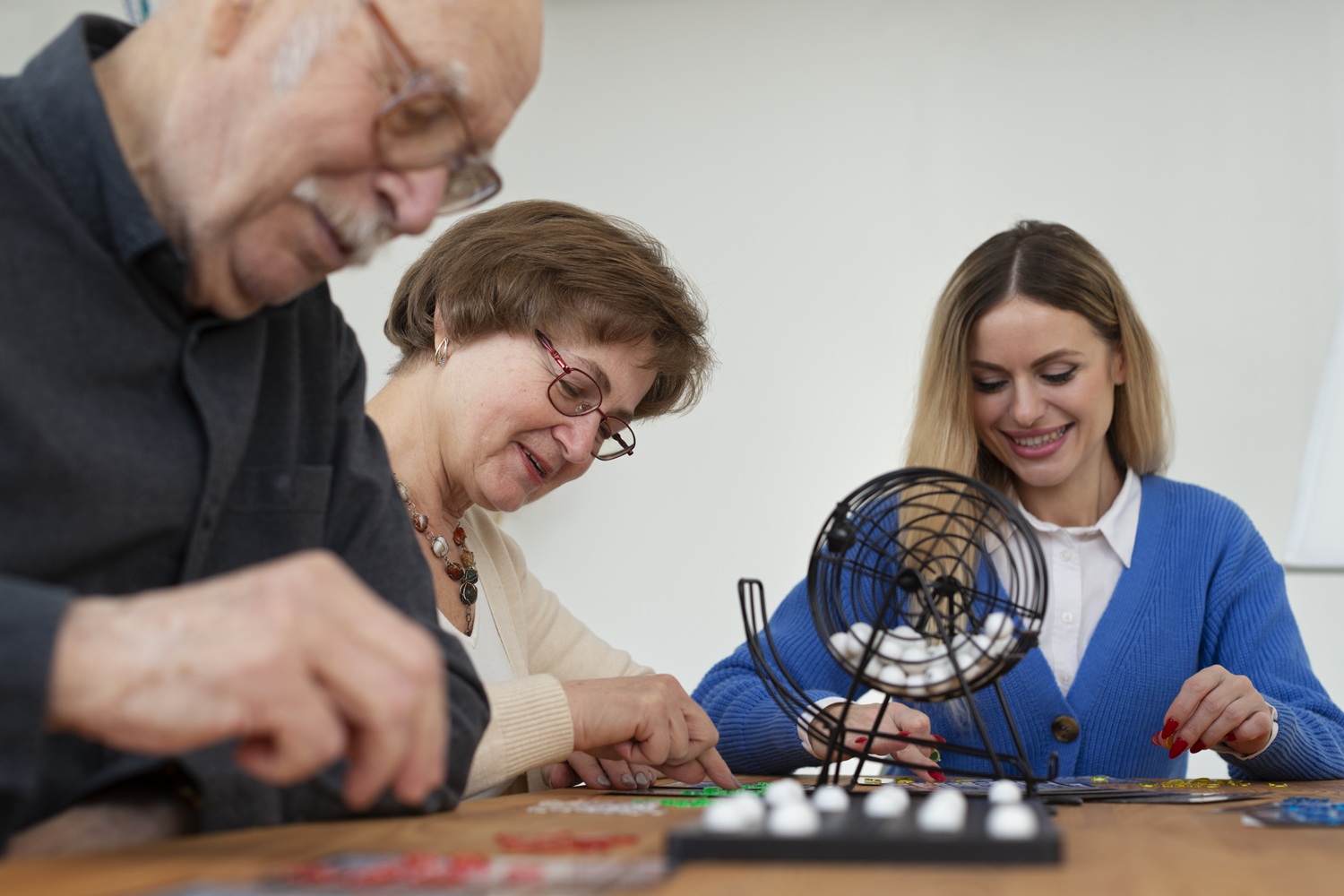
Some evenings, the best reset is not another screen or another stream of information. It is the feel of parts in your hands, the quiet logic of an instruction sequence, and the small satisfaction of watching a mechanism finally move the way you expected.
That is where STEM activities for adults can feel less like school and more like a rewarding hobby. Science, technology, engineering, and mathematics become practical when you use them to understand motion, trace cause and effect, compare two results, or improve a build that did not work on the first try.
You do not need advanced equations or a laboratory. A mechanical model, marble run, biomimetic creature, or pendulum toy can give you a real system to observe. The goal is not to turn your workbench into a classroom. It is to make curiosity part of the build.
A hands-on hobby becomes a STEM activity when you ask one useful question, test what happens, and let the result guide your next step.
What Makes a Hands-On Hobby a STEM Activity?
Many adult hobbies already contain STEM thinking. Woodworking uses measurement and structure. Model building uses sequencing, spatial reasoning, and mechanical relationships. Repair projects use diagnosis and testing. Even a small kinetic display can reveal balance, friction, timing, and energy transfer.
The difference is attention. Instead of assembling only to reach the finished object, you pause long enough to notice how the system works.
- Observation
- Notice which parts move, where resistance appears, and what changes after an adjustment.
- Mechanism
- Trace how one input travels through levers, gears, tracks, rods, or balance points.
- Measurement
- Use simple counts, timing, alignment checks, or distance comparisons when they clarify the result.
- Iteration
- Test, adjust one thing, and test again instead of treating the first outcome as final.
- Reflection
- Explain what happened in plain language so the lesson stays with you after the build is finished.
1. Rebuild a Familiar Machine
Familiar machines make strong adult STEM projects because the result is easy to understand. A typewriter, printing press, clock, or telegraph has a clear input and output, but the path between them is full of mechanical decisions.
Before assembly, identify the actions the finished machine must perform. A typewriter needs a key press to create a mark, move the carriage, and prepare for the next character. During the build, look for the parts responsible for each step. When the machine works, you are not only seeing a vintage object; you are seeing a sequence of linked solutions.
The ROKR Mechanical Typewriter LK703B is designed as a working model with moving keys, a rolling carriage, an ink ribbon, and a line-end bell. The finished build can type on paper, which gives adult hobbyists a direct way to compare the mechanism they assembled with the output it produces.

Try this: before the first typing test, write down which part you expect to move after a key press. Then type one short line and compare the real sequence with your prediction.
2. Turn a Marble Run Into a Motion Lab
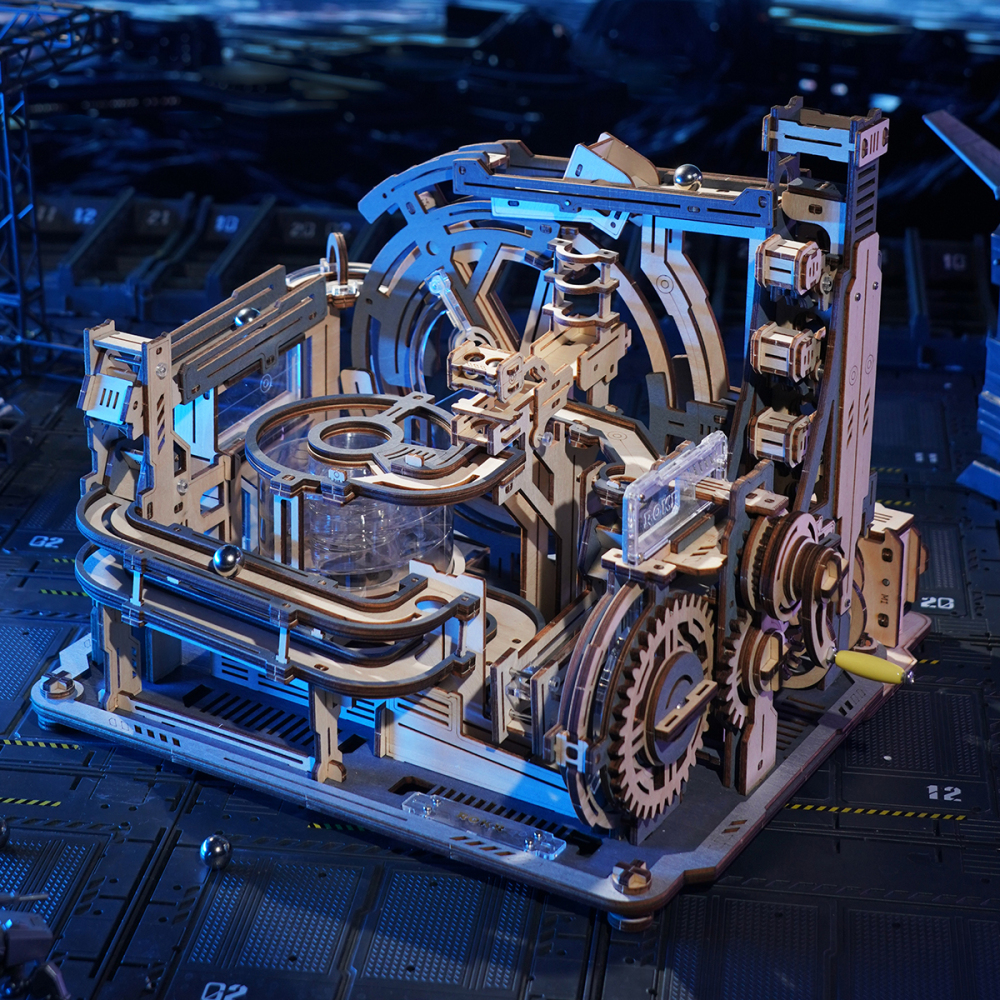
A marble run gives immediate feedback. The ball accelerates, slows, changes direction, disappears into a mechanism, and reappears on another level. Each section offers a small question about slope, friction, timing, or route design.
Start by tracing the complete path without running a ball. Mark the places where you expect the greatest speed change. Then run the system and watch the same points. You do not need precise instruments; a simple slow, medium, or fast note is enough to compare prediction with observation.
ROKR Marble Spaceport uses layered tracks, diversion mechanisms, and manual or electric drive modes. That makes it useful for studying both the ball's journey and the system that keeps the cycle moving. The activity is not about declaring one route better. It is about noticing how separate track sections cooperate as one kinetic system.
3. Study Biomimicry Through a Mechanical Creature
Biomimicry begins with a useful design question: what can a machine learn from a living form? Adult model builders can explore that question by comparing the silhouette and movement of an animal with the rods, gears, joints, or linked parts used to represent it.
Before building, look at a real manta ray in motion and sketch the broad shape of its fins. Then inspect the mechanical parts and predict how the model will create a similar rhythm. The mechanism will not reproduce biology exactly, and that is the interesting part. It shows how designers simplify a natural movement into parts that can be assembled and repeated.
The ROKR Manta Ray MI06 uses synchronised fin movement and a linked transmission to turn a marine form into a mechanical display. For a hands-on adult hobbyist, the finished motion provides a clear point of comparison between natural inspiration and engineered interpretation.

4. Explore Balance With a Pendulum Toy
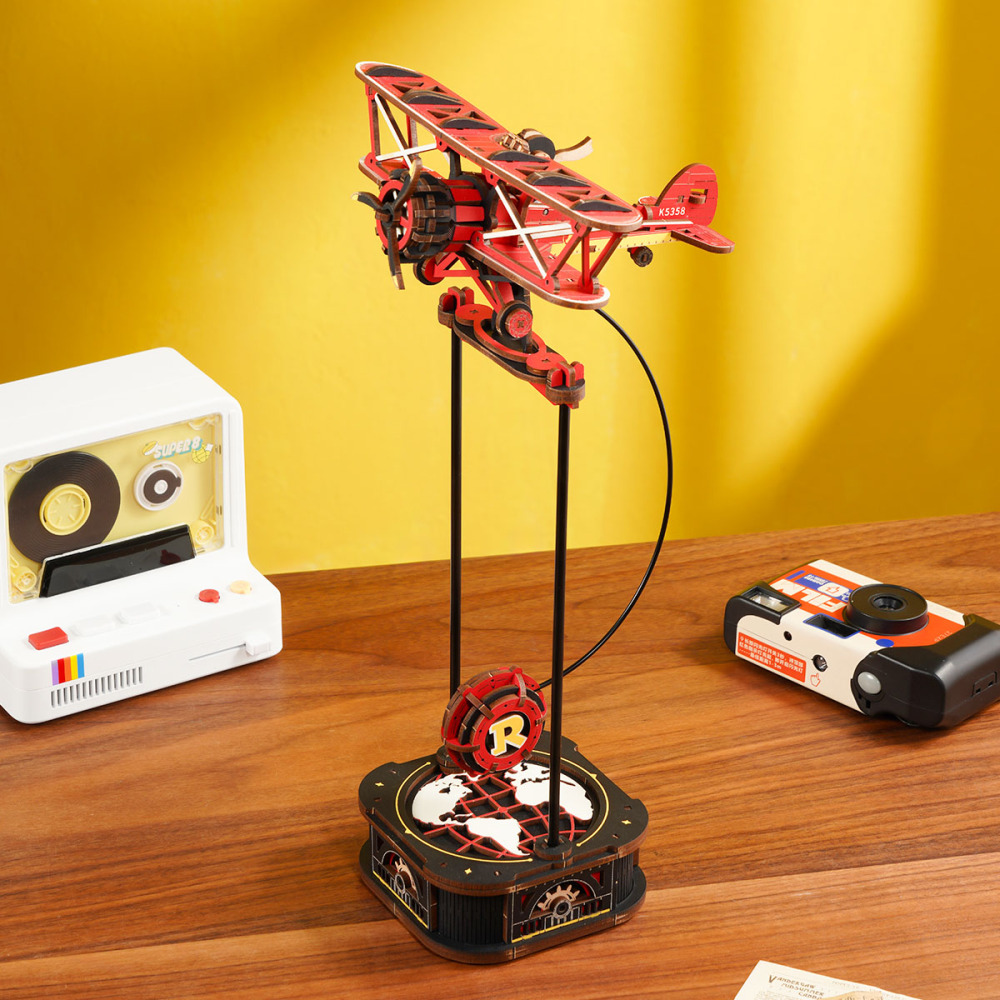
A pendulum-style toy is a compact way to observe balance and repeated motion. A small push creates a visible pattern, and repeated swings make it easier to compare one start with another.
Use gentle, repeatable pushes and count ten swings. Try again with a slightly different starting position, then note whether the motion looks steadier, shorter, or longer. The purpose is not laboratory precision. It is learning how to make a fair comparison by changing one condition at a time.
ROKR Sky Captain MCD01 places a red biplane in a pendulum balance scene. Its desktop scale and visible swinging path make it a lighter entry point for adults who want to explore motion without committing to a long, complex build.
5. Make a Build Notebook Part of the Hobby
A build notebook does not need to look like a lab report. One page can hold a sketch, a prediction, a problem, and the change that solved it. The habit matters because it turns a frustrating moment into useful evidence.
- Choose one question about the mechanism before you begin.
- Write a short prediction in your own words.
- Assemble or test until you can observe the relevant part.
- Change one variable, alignment, or starting condition at a time.
- Record what changed and what you would try next.
Photographs can help, especially when a mechanism has several layers. Take one image before disassembly or correction and another after the change. Over time, the notebook becomes a personal library of mechanical patterns and problem-solving habits.
Choose the Right STEM Challenge for Your Hobby Style
The best project is not always the hardest one. Choose the kind of feedback that keeps you interested: functional output, fast motion, nature-inspired movement, or quiet repetition.
| Activity style | STEM lens | Good fit for adults who enjoy | What to record |
|---|---|---|---|
| Mechanical invention | Sequencing, linkage, input and output | Longer, detail-focused builds and functional objects | Which movement triggers the next step |
| Marble run | Motion, routing, slope, and timing | Kinetic feedback and repeated observation | Where speed or direction changes |
| Mechanical species | Biomimicry and transmission | Nature-inspired design and moving display pieces | How natural movement is simplified |
| Pendulum toy | Balance and repeated motion | Compact builds and short observation sessions | How the starting condition changes the swing |
How to Keep an Adult STEM Hobby Relaxing
STEM thinking should deepen the hobby, not turn it into another performance target. Keep the process light enough that curiosity still has room to work.
- Ask one question A narrow question is easier to observe than trying to understand the entire model at once.
- Pause before correcting Look at the problem long enough to form a theory before moving parts at random.
- Measure only what helps A count, sketch, or timing note is useful when it clarifies a comparison, not when it adds paperwork.
- Respect your pace Stop at a clean step and return later if attention is fading.
- Display the result A finished model keeps the mechanism visible and makes it easier to explain what you learned.
Adult STEM Activities FAQ
Do STEM activities for adults require advanced mathematics?
No. Many useful activities rely on observation, sequencing, comparison, basic timing, and clear explanations. Mathematics can be as simple as counting swings or comparing two routes.
Can model building count as a STEM activity?
Yes, especially when you trace how parts interact, predict an outcome, test the mechanism, and use the result to make an adjustment.
What is a good first STEM project for an adult hobbyist?
Start with a mechanism you can see and a session length you will enjoy. A pendulum toy offers quick feedback, while a mechanical invention or marble run suits adults who want a longer build with more relationships to trace.
Conclusion
Hands-on STEM activities for adults do not need to feel academic. They can begin with a quiet evening, a set of parts, and one question about how movement travels through a system.
Rebuild a familiar machine, follow a marble through a layered route, compare animal motion with a mechanical linkage, observe a pendulum, or keep a notebook of small discoveries. The finished model matters, but so does the moment when the mechanism stops being mysterious and starts making sense in your hands.