Curiosity does not end when school does. Many adults still want to know why planets move at different speeds, how a lens brings a distant object into focus, what ordinary materials look like under magnification, or how a complex machine coordinates several actions at once. They may not be scientists or engineers, but they enjoy observing closely, following a system, and understanding how its parts work together.
A useful test: That is why an adult STEM gift should not feel like a classroom prop with a scientific theme printed on the box. A meaningful STEM gift gives the recipient something to build, operate, observe, and continue exploring after the assembly is complete.
ROKR's Curious Discovery collection approaches science through working and displayable models. The strongest choice, however, is not automatically the largest kit or the one with the most pieces. It is the model that matches the question the recipient already wants to investigate.
What Makes a Good STEM Gift for an Adult?
1. It matches an existing interest
Start with the person, not the product. Someone who follows astronomy news may appreciate a mechanical orrery. A traveler may return more often to a globe. A maker who studies paper, fabric, plants, printing, or surface texture may get more lasting use from a microscope.
Useful interest areas include:
- Astronomy and planetary motion
- Geography, travel, and maps
- Optics and distant observation
- Biology, materials, and the microscopic world
- Mechanical engineering and gear transmission
- Space exploration and engineered systems
The subject does not need to match the recipient's profession. It only needs to connect with something they already notice, read about, collect, photograph, or discuss.
2. It offers a meaningful building experience
The finished object matters, but so does the route to it. A good kit asks the builder to understand sequence, alignment, structure, and motion rather than simply decorate a shell.
Before choosing, consider the estimated assembly time, difficulty, size of the parts, and how much patience the mechanism demands. Visible gears and adjustable components can make the process especially rewarding because the builder can see how one step affects the final operation.
3. It remains useful or interesting after assembly
Some models invite repeated operation. Others become observation tools, mechanical demonstrations, or substantial study displays. The strongest adult STEM gifts have a second life after the last piece is fitted.
Ask what the recipient will be able to do next:
- Turn a crank and follow the motion through a gear train
- Adjust focus and observe a distant or magnified subject
- Rotate a globe and compare locations
- Demonstrate a launch sequence
- Display the model in a study, office, or workshop
- Use the finished object as a starting point for further reading
4. It fits the recipient's experience level
More pieces do not automatically make a better gift. A first-time builder may enjoy a focused 2.5-hour project more than an eight-hour structural challenge. An experienced model maker, on the other hand, may want a build that occupies a full weekend and rewards careful alignment.
Think about whether the recipient prefers short projects, long sessions, visible mechanical systems, or precise decorative assembly. Build time and difficulty should match the person's habits, not the giver's idea of what looks impressive.
If experience is difficult to judge, start with this guide to wooden model kits by age and experience.
ROKR STEM Gifts at a Glance
| Model | Best for | Main subject | Build difficulty | Approximate build time | Finished experience |
|---|---|---|---|---|---|
| Mechanical Orrery ST001 | Astronomy and gear enthusiasts | Planetary motion and variable-speed gear transmission | 4/5 | 7 hours | Hand-cranked orbital motion, a lighted sun, and a large desktop display |
| Microscope ST005 | Adults who enjoy close observation | Magnification, focus, illumination, and material detail | 4/5 | 6 hours | Functional observation at 4x, 10x, and up to 40x magnification |
| Luminous Globe ST003D | Travelers, map lovers, and home offices | Geography, spatial relationships, and map reading | 4/5 | 4-8 hours | Rotating globe, movable magnifier, warm light, and interactive display |
| Monocular Telescope ST004 | First-time builders and optical curiosity | Lens position, magnification, and focus | 3/5 | 2.5 hours | Simple long-distance observation and a detachable retro display |
| The Globe ST002 | Experienced builders seeking a larger challenge | Spherical structure, geography, and load-bearing rings | 4/5 | 8 hours | A 52 cm-tall rotating globe with strong study-display presence |
| Space Shuttle LKA02 | Space exploration and engineering fans | Coordinated mechanisms, launch systems, gears, and lighting | 5/5 | 6 hours | A motorized launch-preparation sequence with moving arms and light effects |
Assembly times are manufacturer estimates. A first build may take longer, especially when the recipient prefers to work slowly, check alignment, or divide the project across several sessions.
1. Mechanical Orrery ST001: Best for Astronomy and Mechanical Motion Enthusiasts
The design of the Mechanical Orrery ST001 begins with an old human problem: how can the motion of the solar system be translated into something visible and mechanical? ROKR's answer is not a static arrangement of colored planets. It is a hand-operated model built around transmission.
One turn of the crank enters a multi-stage, variable-speed gear system. From there, motion is distributed across layered tracks so that eight planets travel around the central sun at different speeds. The same hand-cranking action generates the energy that illuminates the sun. A builder can follow the full chain from input to transmission to several simultaneous outputs.
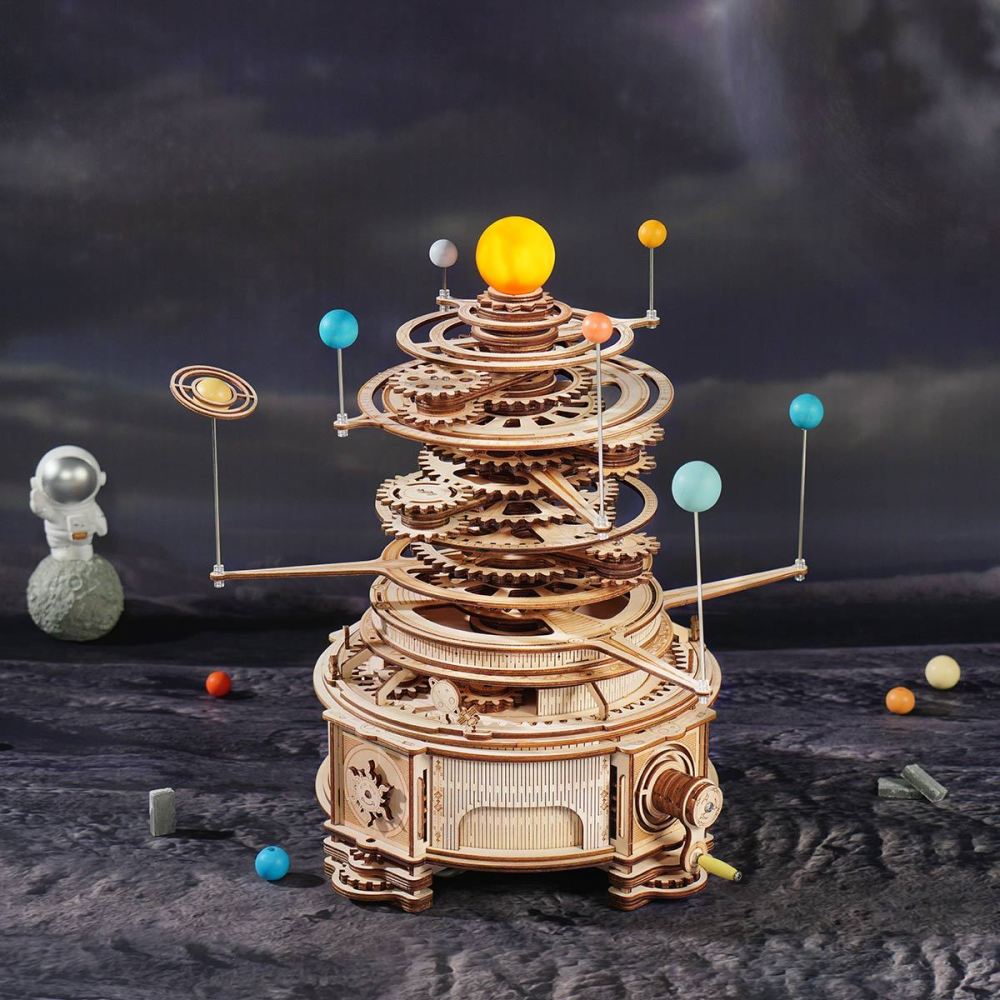
This is what separates ST001 from a general astronomy ornament. It gives an astronomy enthusiast a simplified model of orbital movement and gives a gear enthusiast a mechanism to trace. The question at its center is mechanical as much as astronomical: how can one manual input create several movements at different speeds?
The 316-piece build is rated 4/5 in difficulty and takes about seven hours. Careful gear alignment matters, so it is better suited to someone who enjoys a long, methodical project than to someone looking for a quick result. Once finished, the model can be cranked repeatedly to compare orbital speeds, observe how motion is distributed, and light the central sun.
Scale is the important limitation. ST001 is a mechanical interpretation of the solar system, not an astronomical simulator. It does not reproduce true distances and proportions, show current planetary positions, or predict eclipses. It also measures approximately 40 x 40 x 35 cm, so the recipient will need a generous desk, shelf, or display area.
2. Microscope ST005: Best for Adults Who Enjoy Close Observation
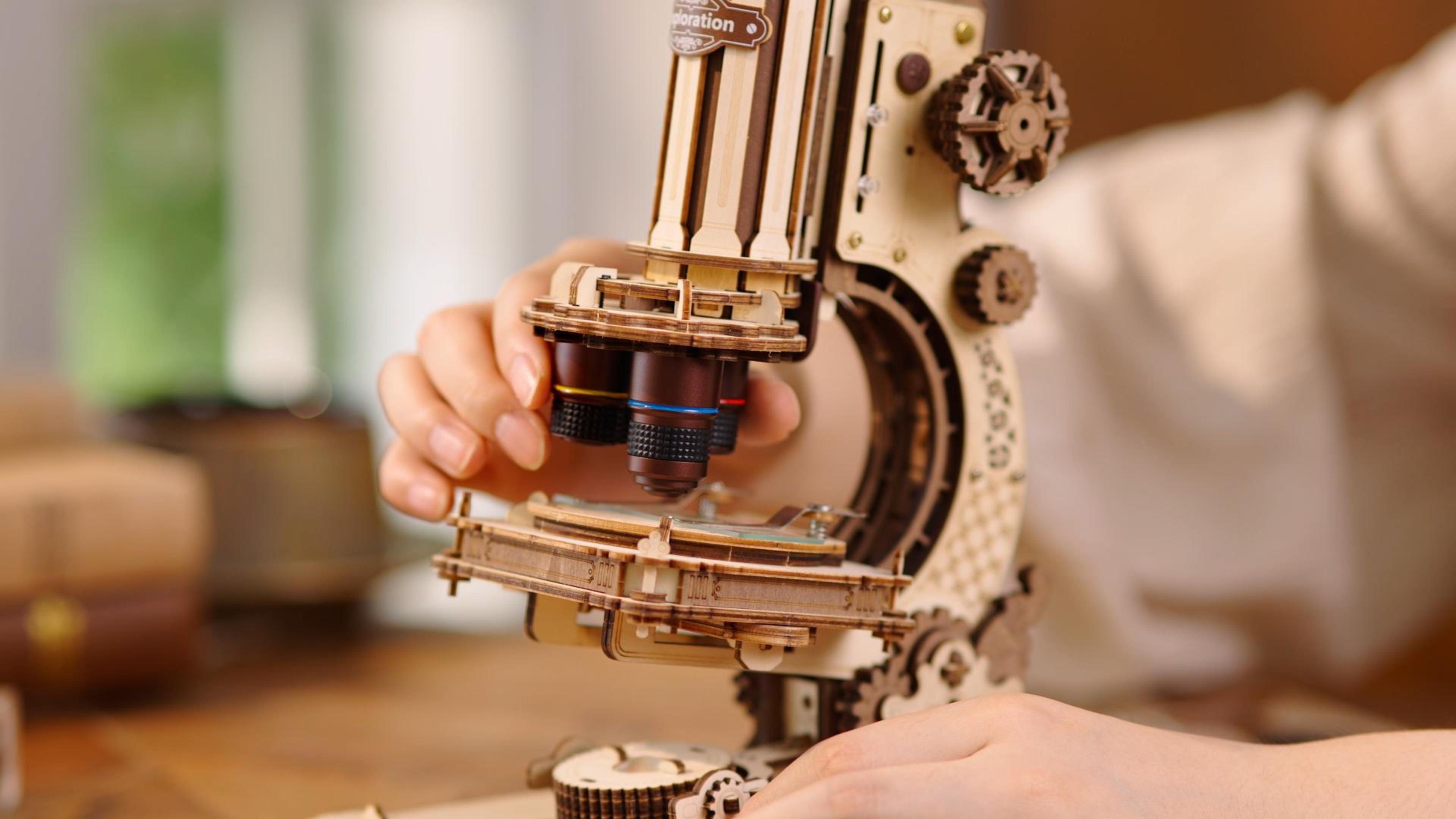
Place a leaf, a strand of fabric, or a piece of printed paper beneath the Microscope ST005, and the project begins again. Assembly creates the instrument; observation gives it an ongoing purpose.
The revolving lens assembly offers 4x, 10x, and up to 40x magnification. Focus, illumination, filters, and sample position also affect the result, so the user is not simply making an object look larger. They are learning to ask what becomes visible when magnification, focus, and light change together.
What can the recipient examine?
- Leaf veins, petals, and other small plant details
- Paper fibers, printed dots, and ink patterns
- Woven fabric, thread, and craft materials
- Wood grain, surface texture, and other everyday samples
That continued observation makes ST005 especially thoughtful for gardeners, printers, textile crafters, artists, collectors, and anyone who tends to notice material detail. A person can prepare a new sample in a few minutes, compare it at different magnifications, and return to the microscope long after the build itself is finished.
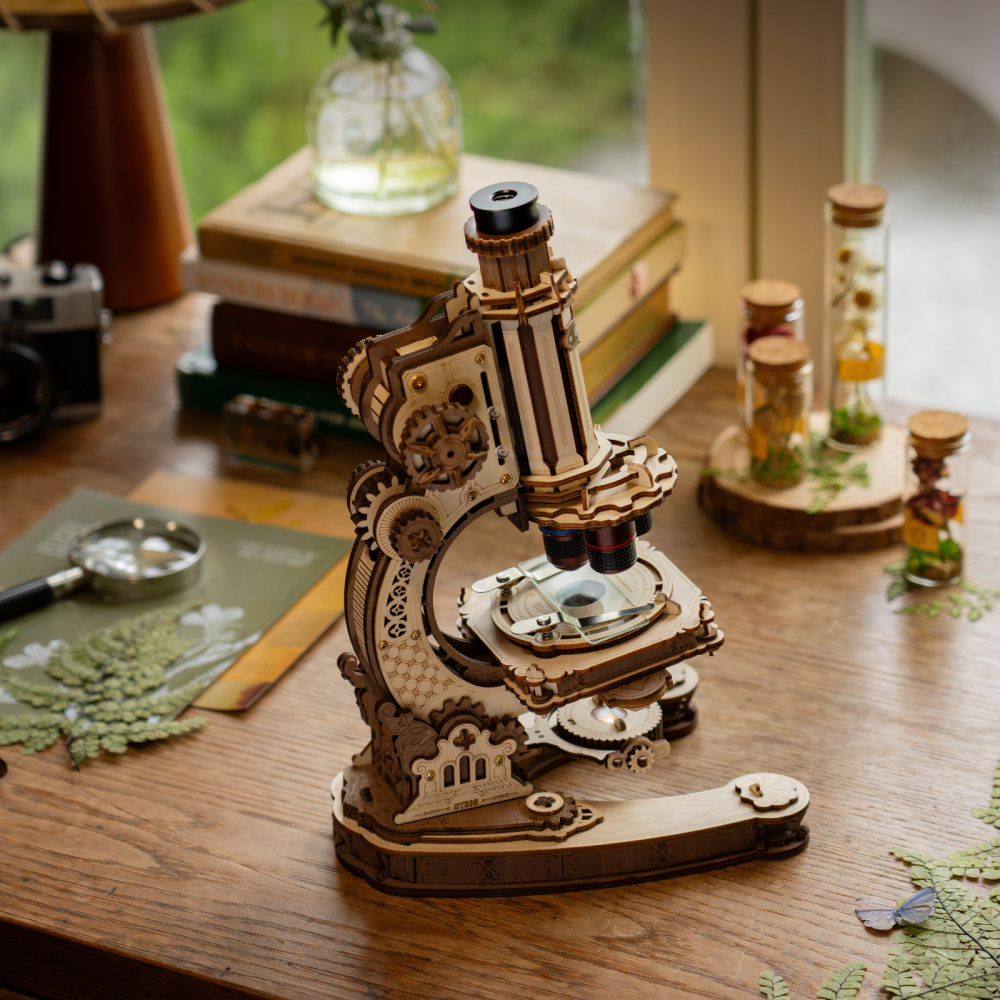
The assembly remains substantial: 260 pieces, a 4/5 difficulty rating, and an estimated six-hour build. Lens position, focus control, illumination, and the sample stage have to work together, giving the project more functional precision than a purely decorative model.
Its practical limit is equally important. ST005 is a working wooden observation model, not a professional laboratory microscope. It is intended for close looking and experimentation rather than clinical use, high-resolution research, or precise scientific measurement. Between sessions, its vintage scientific-instrument form gives it a natural place on a desk or shelf.
3. Luminous Globe ST003D: Best for Travelers, Map Lovers, and Home Offices
Some people keep a globe nearby because it helps them think. They turn it while planning a trip, locate a country mentioned in the news, or trace the ocean between two places they know. The Luminous Globe ST003D is designed for that kind of desk or study.
It suits the traveler who still enjoys maps after the itinerary is booked, the home-office worker who follows international events, and the reader who wants geographic context within reach. At roughly 30 cm tall, it has enough presence to anchor a shelf or side table without taking over the room.
The globe rotates, the world map glows with warm light, and a movable 25 mm magnifier helps the user inspect regions more closely. Those interactions can lead from a single location to wider questions about distance, latitude, hemispheres, and how our position on Earth shapes the way we understand places and events.
ST003D is also a build rather than ready-made decor. Its 185 pieces form the frame, map structure, controls, magnifier path, and lighting. ROKR rates it 4/5 in difficulty with an estimated assembly range of four to eight hours, making it a moderate project for someone who wants both a making experience and an object that remains useful in the room.
Think of the finished result as an interactive geographic display. It can support casual map reading and conversation, but it is not a navigation device, surveying instrument, or continuously updated political reference.
4. Monocular Telescope ST004: Best for First-Time Builders and Optical Curiosity
For a first ROKR gift, the Monocular Telescope ST004 has an important advantage: the recipient understands the goal before opening the box. Build the instrument, adjust the tube, look through the eyepiece, and bring a distant object into focus.
Why it works as a first build
- The time commitment is manageable. The estimated assembly time is about 2.5 hours, the shortest in this guide.
- The difficulty is moderate. ROKR rates it 3/5, making it less demanding than the orrery, microscope, or space shuttle.
- The function is easy to test. The recipient can try the monocular as soon as the body and adjustable tripod are complete.
The specifications still give the builder real optical relationships to explore. ST004 uses a 20 mm eyepiece, a 30 mm objective lens, and a three-section telescopic tube. Extending or shortening the tube changes the lens relationship until a distant subject comes into focus. The finished monocular provides approximately 3x magnification and is intended for simple viewing at distances of up to 150 meters.
Its 314 pieces also show why piece count should not be treated as a difficulty score. The project has many components, but they form a recognizable, relatively direct structure. Afterward, the telescope body can be removed from the tripod for simple distant observation or returned to the stand as a retro display inspired by navigation and exploration.
That function has a clear boundary. ST004 is a working monocular model for basic terrestrial viewing, not a professional astronomical telescope for observing planets, deep-sky objects, or fine celestial detail.
5. The Globe ST002: Best for Experienced Builders Who Want a Larger Challenge
Choose The Globe ST002 over ST003D when the recipient is more excited by constructing a large sphere than by adding a lighted object to the room. Here the central STEM problem is structural: how can flat components and layered rings form a stable spherical model?
The 567-piece build uses ring ribs and fitted map sections to produce a globe with Earth's familiar 23.5-degree axial tilt. As the structure grows, the builder has to think about curvature, support, balance, and alignment. The geographic surface matters, but the engineering of the sphere is what makes the assembly distinctive.
ST002 compared with ST003D
| Choose ST002 when... | Choose ST003D when... |
|---|---|
| The recipient wants the longer, larger build | The recipient wants a more moderate project |
| Structural assembly is part of the appeal | Warm lighting and map interaction matter more |
| A 52 cm statement display fits the room | A roughly 30 cm globe fits the available space better |
| Eight hours and 567 pieces sound rewarding | A four-to-eight-hour, 185-piece build feels more suitable |
ROKR rates ST002 4/5 in difficulty and estimates about eight hours of assembly. It is the largest and longest project in this selection, and its finished scale makes the transformation from flat sheets to a supported globe especially visible.
Once complete, the globe rotates for geographic viewing, incorporates storage in its base, and has enough presence to become a central study display. The tradeoff is space and patience: ST002 needs careful alignment, a long work session or full weekend, and a substantial permanent location.
6. Space Shuttle LKA02: Best for Space Exploration and Engineering Fans
The Space Shuttle LKA02 approaches space from a different direction than ST001. The orrery interprets natural celestial motion. The shuttle focuses on the systems people design to prepare a spacecraft for launch.
Question this gift makes tangible: How do multiple engineered systems work together during a space mission?
The answer unfolds as a sequence rather than a single motion:
- The powered track begins raising the shuttle from its horizontal position.
- The model moves toward a vertical launch stance.
- The tower's mechanical arms rotate and retract while signal lights flash.
- Light effects appear beneath the boosters to complete the launch-preparation display.
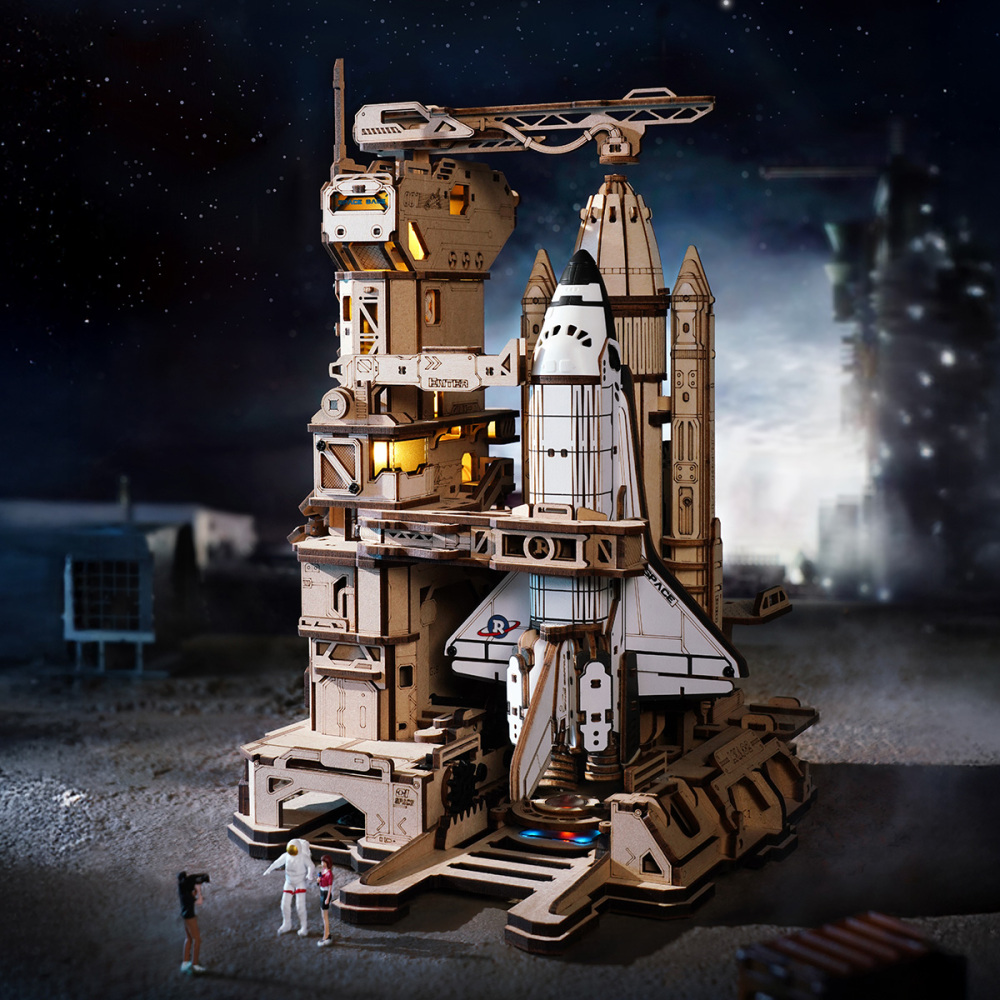
The value lies in watching those actions coordinate. A spaceflight enthusiast receives a model centered on human engineering, while a mechanically minded builder can study how gears, a motor, the lifting path, tower components, and lights contribute to one demonstration. It can be run repeatedly after assembly, so the finished model behaves more like a small mechanical exhibit than a static spacecraft.
After the mechanism is working, these Space Shuttle display and customization ideas show how builders continue using the finished model.
This is also the most demanding build in the group by rating. LKA02 contains 446 pieces, carries a 5/5 difficulty level, and takes about six hours. Gear movement, the track, launch structure, and moving arms all require attention, making it a better gift for a confident builder than for someone seeking the easiest first kit.
The model is an engineering-inspired launch display, not a flight simulator or an exact replica of a working launch facility. Its powered functions require a 5V Type-C connection, and the cable is not included.
Which ROKR STEM Gift Should You Choose?
For the astronomy enthusiast
Choose Mechanical Orrery ST001. It connects planetary motion with a visible variable-speed gear system and lets the recipient compare several movements driven by one crank.
For the close observer
Choose Microscope ST005. Its value continues after assembly because the recipient can collect and compare everyday materials under different magnification, focus, and lighting conditions.
For the traveler or map lover
Choose Luminous Globe ST003D. It offers geographic interaction, warm light, and a movable magnifier in a size suited to a home office or study.
For the new builder
Choose Monocular Telescope ST004. Its shorter build time, moderate difficulty, and clear optical function make it an approachable first ROKR project.
For the experienced model builder
Choose The Globe ST002. Its 567 pieces, ring-based spherical structure, eight-hour build, and 52 cm finished height create the most substantial structural challenge in this group.
For the space engineering fan
Choose Space Shuttle LKA02. It is the better space-themed option when the recipient is more interested in launch systems, mechanical coordination, and human engineering than in planetary motion.
Choose by Build Time and Difficulty
Interest should come first, but available time can decide between two equally appealing themes.
A shorter introductory project
Monocular Telescope ST004 takes about 2.5 hours and is rated 3/5 in difficulty. It suits a recipient who wants to complete a functional object without setting aside an entire weekend.
A medium-length technical project
Microscope ST005 and Space Shuttle LKA02 each have an estimated six-hour build time. ST005 emphasizes optical alignment and observation, while LKA02 carries the higher 5/5 difficulty rating because several mechanical and powered systems must work together.
A full weekend experience
Mechanical Orrery ST001 takes about seven hours, while Luminous Globe ST003D is estimated at four to eight hours. Both reward builders who want to divide the work across several sessions and return to an interactive display.
A large project that demands patience
The Globe ST002 takes about eight hours and has 567 pieces. Its scale and spherical construction make it the clearest choice for an experienced builder who enjoys watching a large structure take shape over time.
For more demanding options beyond this science-focused list, compare challenging 3D wooden puzzles for adults.
Give the Question, Not Just the Kit
When choosing a STEM gift for a curious adult, do not begin by asking which model is biggest, most difficult, or packed with the most parts. Begin with the question the recipient keeps returning to.
Someone who looks closely at materials may keep using a microscope. Someone who follows planets and gears may return to an orrery. A traveler may rotate a globe while planning the next journey. A new builder may learn focus through a monocular telescope. A spaceflight enthusiast may want to watch several engineered systems move through a launch sequence.
That is what makes these models meaningful as gifts. The assembly creates the object, but the recipient's existing curiosity gives it a reason to remain on the desk, in the study, or in regular use. Explore the ROKR Curious Discovery collection by starting with the subject they already want to understand.