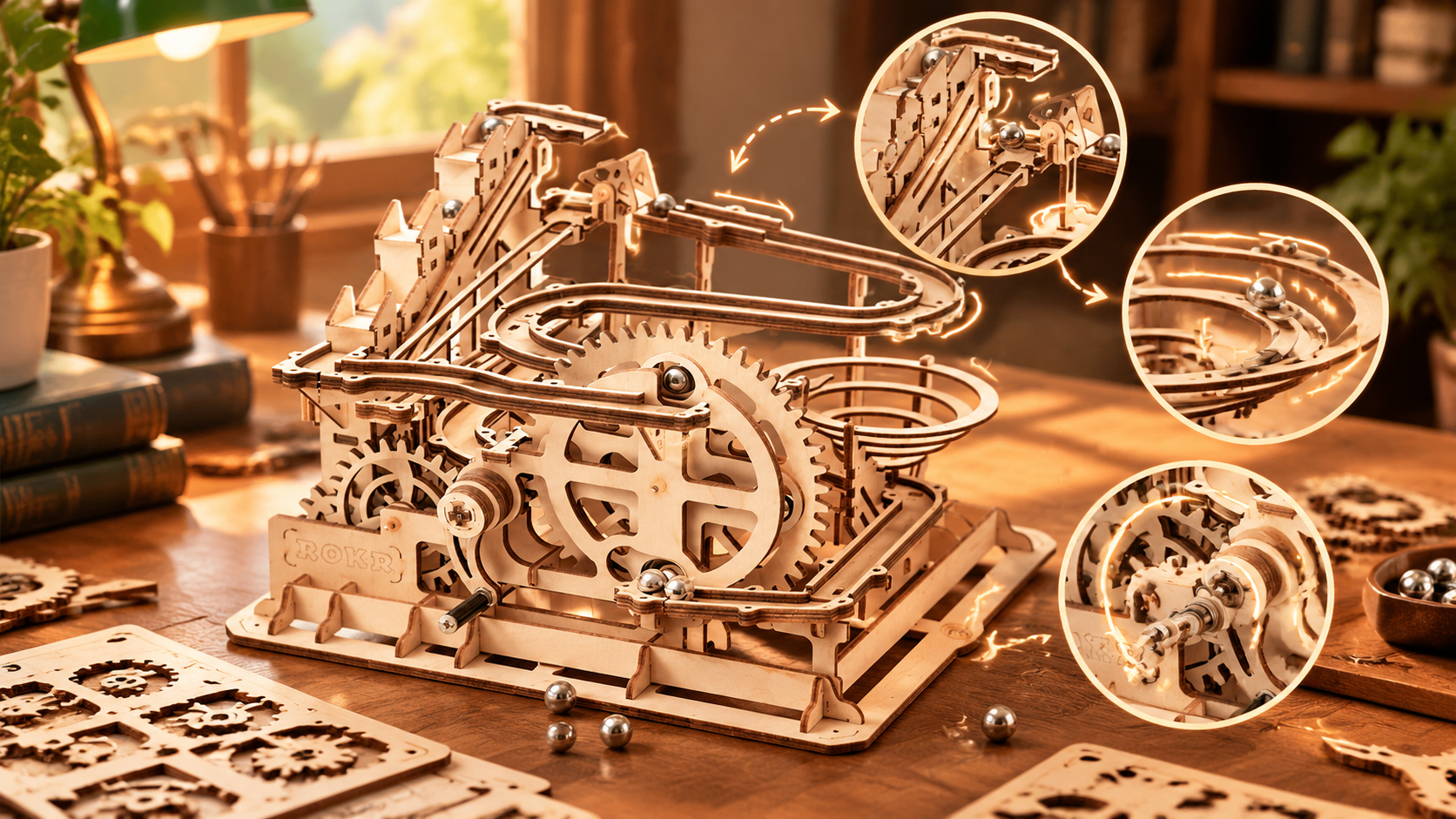
A 3D marble run uses a three-dimensional structure to route the ball through different heights and directions. This makes the path turn, drop, and double back through space instead of tracing a single line across a table.
Many 3D marble runs are sold as kits you assemble yourself. Here is what gives a marble run its three-dimensional character, how the kits go together and operate once built, and what you can expect to find in the box.
What Makes a Marble Run 3D
Three things work together to make a 3D marble run:
Height
Height is the most visible feature. These models usually lift the ball well above the surface they sit on, which gives them presence on a desk. The vertical dimension also lets a long route fit in a small footprint.
ROKR’s Marble Night City assembles to 12.8 by 8.4 inches at the base and stands 9 inches tall. This is a compact space for the layered route inside it.
Track Arrangement and Depth
A run can be three-dimensional without being tall. What counts is how the tracks are arranged relative to one another, with sections sitting in front of and behind each other as well as above and below. That depth gives the ball room to turn and double back.
Depth also changes how a run looks as it works. With tracks layered front to back, some sections pass behind others. Some models use transparent track or clear panels so the ball stays visible as it travels through the middle of the structure.
Structure
The structure is the model. Towers, frames, and supports keep every section at its intended angle and position. Without them, the tracks would be a loose collection of parts, so the structure is as much a part of the design as the route itself.
How 3D Marble Run Kits Work
This question has two sides. One is how the kit becomes a model, and the other is how the model behaves once it is finished.
The Build
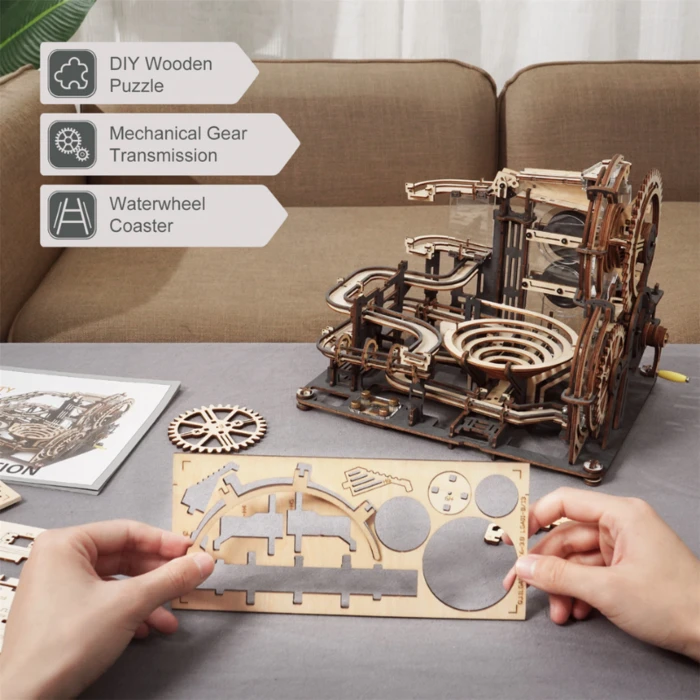
The build varies by brand and material. In wooden kits, such as ROKR’s, the parts arrive attached to laser-cut sheets. You detach them and press-fit them together following a numbered manual.
Other 3D marble run kits use molded plastic components or different joining methods entirely, so follow the manual for your model.
If rough edges or burrs show up on a detached part, smoothing them helps the fit, although not every piece will need it. The build generally works upward from the base, which is why getting the early layers square pays off later.
The Descent
Once built, gravity takes over. The ball enters at a high point and travels down through slopes, spirals, funnels, and drops. The structure holds each section at the angle that keeps it moving. Our guide to how a marble track works covers the physics in more detail.
The Return
On models built to loop, a hand crank or a small motor drives a lift that carries the ball back to the top. Not every model recirculates. Some are designed as one-way descents where you collect the ball at the bottom and return it yourself.
What Comes Inside a 3D Marble Run Kit
Contents vary by model and brand, so check the product listing to confirm what you are getting. That said, a few things are common across wooden kits.
A wooden kit typically includes the pieces for its frame and track. Other common contents include:
- The balls
- A printed instruction manual
- Small assembly aids, such as a nipper, sandpaper, or a pressing tool
The exact contents vary, especially the assembly aids, so check the listing or manual for your kit.
Check for wax and power accessories before you order. Wax may be omitted from some international shipments. If your manual calls for wax and none is included, Robotime lists plain candle wax and beeswax as alternatives for Marble Night City. For a motorized model, check the required power input and whether the cable and adapter are included.
ROKR lists a printed manual with each kit. If yours goes missing or gets damaged partway through a build, look up the model in ROKR’s assembly instructions library to download a digital copy.
3D Marble Run Examples from ROKR
These 3D marble run examples show how differently the same idea can be executed:
- Marble Night City is hand-cranked with no electricity, built from 294 pieces in roughly seven hours. ROKR credits Rube Goldberg’s mechanical comics as the inspiration for its industrial cityscape, part of a long tradition of elaborate contraptions that students still celebrate in the annual Rube Goldberg Machine Contest.
- Marble Travel London builds the London Eye, Big Ben, and Tower Bridge into the structure itself, with 431 pieces and automatic operation from a USB-C connection.
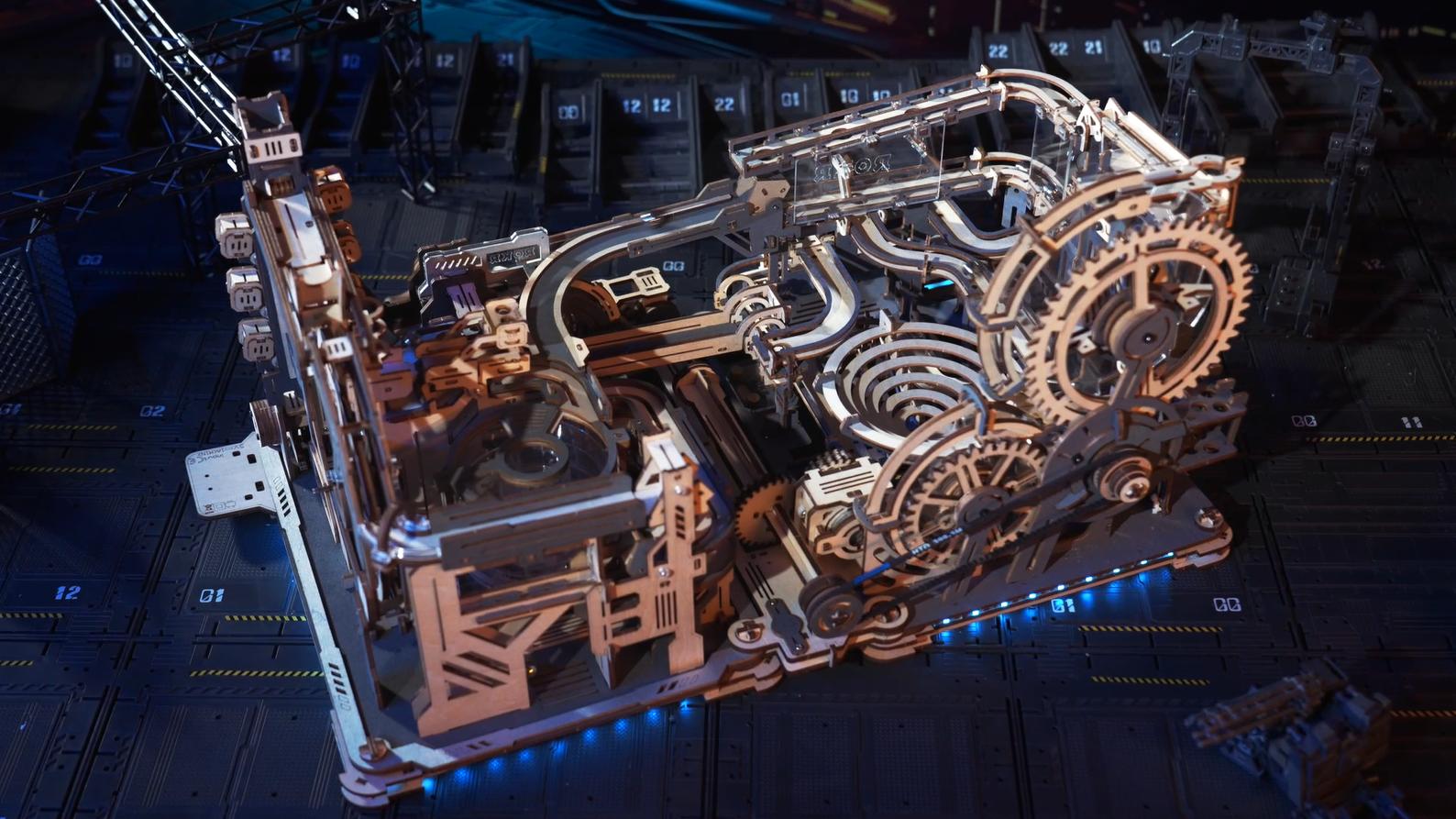
- Marble Spaceport has 472 pieces, six diversion mechanisms, and five layered tracks. It offers both manual and electric drive.
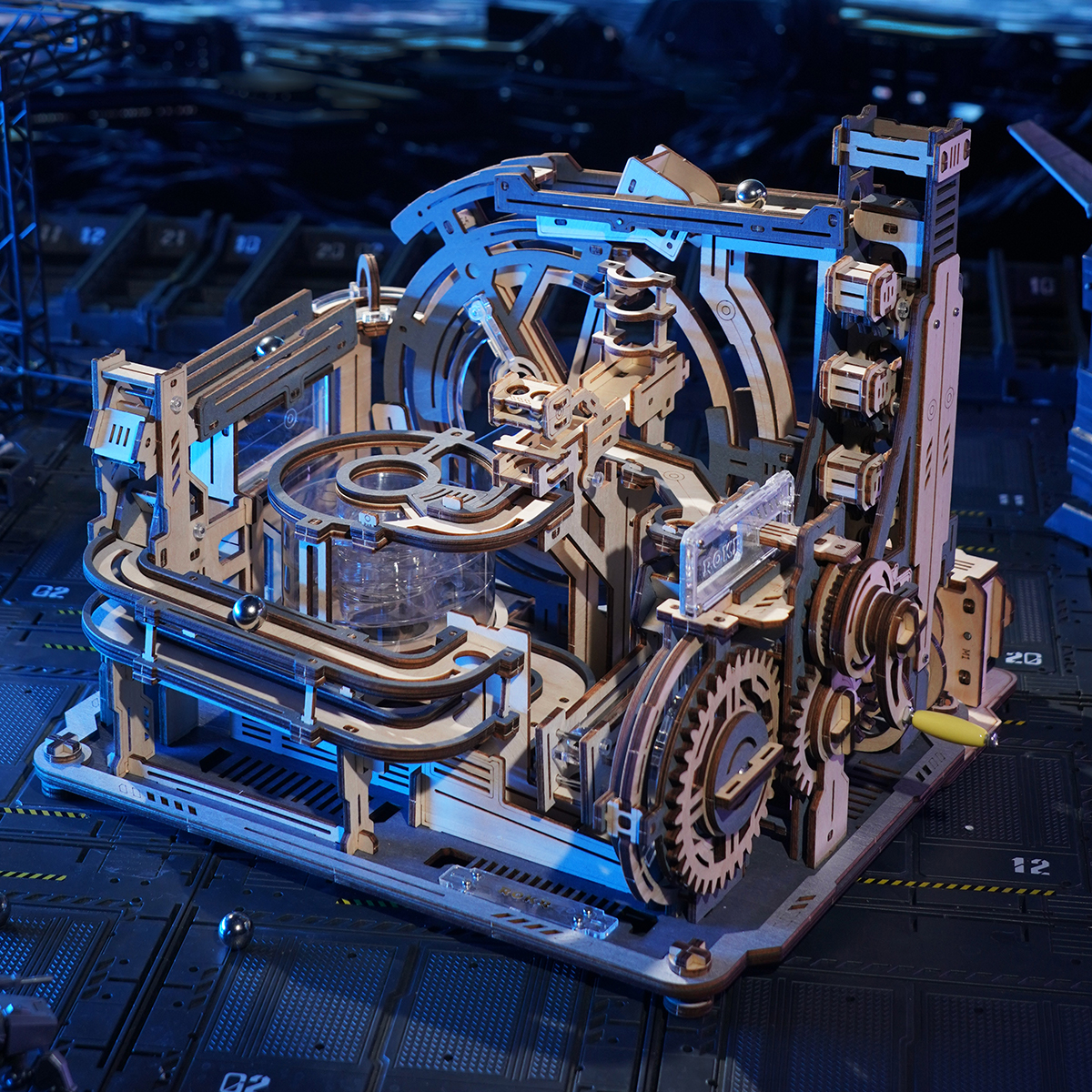
The assembled Marble Spaceport shows how track layers fit inside the frame. - The Parallel World range is a modular system, so you can link models to extend the circuit.
FAQs About 3D Marble Runs and Kits
Is a 3D marble run the same as a 3D wooden puzzle?
3D marble run and a 3D wooden puzzle describe different things, but they overlap. A 3D marble run refers to the structure and track layout, meaning how the ball is routed through space. A 3D wooden puzzle describes the assembly format, meaning a model you build from wooden parts. ROKR marble runs are both, which is why the terms appear together so often.
How long does a 3D marble run take to build?
Build time depends on the model and your pace. ROKR estimates about five hours for Marble Travel London, five and a half for Marble Spaceport, and seven for Marble Night City. Smaller or simpler models may take less time.
Do you need glue or extra tools?
The featured ROKR wooden kits use press-fit joints for normal assembly. If a part is damaged, check the manual before using glue or another repair method. The Building Tips & Tutorials page covers useful tools and techniques.
Can you leave a 3D marble run assembled?
Yes, you can leave a 3D marble run assembled. The finished structure can stay together as a display piece. Keep a wooden model in a dry spot away from direct sunlight and prolonged heat, where it is less likely to warp over time.
Browse Our 3D Marble Run Collection
A 3D marble run is defined by how its structure routes the ball through heights, turns, and directions. The kit is how you get that structure into your hands. Once you know what to look for in the layout, build, and box contents, comparing models gets much easier. You can see how the designs differ across the Marble Run collection.