
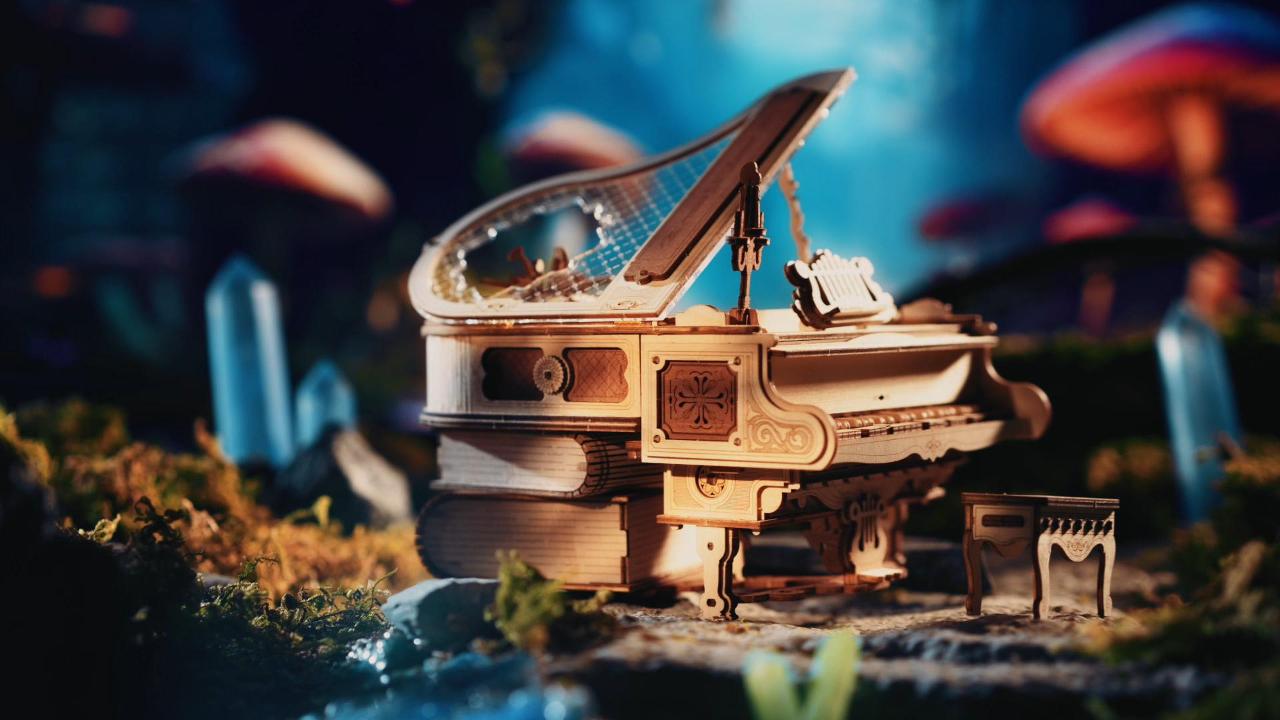
DIY kits were once easy to describe as temporary projects: build them, enjoy the finished shape, and eventually set them aside. That view is changing. Many adult builders now look for objects with stronger design intent, longer display life, and a sense of ownership that does not disappear when the last piece clicks into place.
ROKR mechanical models sit in that shift. They are still hands-on kits, but they are designed to become objects worth keeping: visible on a desk, shelf, or workspace, and connected to the attention of the person who built them.
From DIY Project to Design Object
A collectible design object needs more than a good silhouette. It needs structure, purpose, and a reason to stay in view. ROKR approaches this through exposed mechanics, engineered rhythm, and scenes that invite people to look closer rather than glance once and move on.
- Engineering aesthetics Gears, frames, and linkages are left visible so the mechanism becomes part of the visual language.
- Functional motion Many models are built around movement or utility, not decoration alone.
- Hands-on ownership The builder understands the object from the inside because they assembled its structure piece by piece.
- Display longevity A finished kit can live as decor, a conversation piece, or a reminder of focused work.
Mechanical Art, Functional Art, Kinetic Object
The source idea behind the article is simple: ROKR balances mechanical art, engineering aesthetics, and kinetic object design. Those phrases sound close, but each points to a different part of the experience.
- Mechanical art
- The mechanism is not hidden. Gears, frames, and motion are part of what the viewer is meant to appreciate.
- Functional art
- The finished build can do something useful or interactive, such as keeping time, playing music, projecting a scene, or offering tabletop play.
- Kinetic object
- Movement gives the model rhythm. The object changes as it operates, which makes it feel alive on display.
This is why a ROKR model can feel different from a purely decorative craft. A clock, a printing press, a vitascope projector, a mechanical music box, a tabletop pinball machine, or a lighted build gives the eye a reason to return. The moving parts are not only ornamental; they help explain what the object is.
Why Exposed Mechanisms Matter
In many household objects, the mechanism disappears behind a clean shell. ROKR reverses that instinct. The structure is visible, and that visibility is part of the appeal. A builder can see cause and effect unfold: a gear turns, a platform moves, a rhythm repeats, and the model becomes legible as a small machine.
That legibility makes the finished piece easier to value. It is not just a wooden form; it is a record of mechanical logic. For collectors, this gives the object depth. For makers, it turns assembly into a way of understanding how form and function meet.
| Traditional DIY kit | ROKR collectible approach |
|---|---|
| Often valued mainly for the finished appearance. | Values the finished appearance, the visible structure, and the mechanical idea behind it. |
| The build may feel separate from the final display. | The assembly process becomes part of the object's personal meaning. |
| Decorative pieces can lose interest once the novelty fades. | Motion, utility, and exposed design give the object more reasons to stay in use or on display. |
Assembly as Personal Craftsmanship
The assembly process is not a side note. It is one of the reasons these kits become meaningful. Building asks for focus, sequencing, and patience. As each piece comes together, the builder experiences structure and mechanical flow in real time rather than reading about them abstractly.
That is where the object becomes personal. Two people may own the same kit, but the finished model still carries the memory of the particular build: the careful alignment, the small adjustments, the first successful movement, and the final decision of where it belongs.
Built for Long-Term Display
ROKR kits are designed to remain visible after assembly. They can sit on desks, bookshelves, and workspaces as kinetic design pieces and conversation starters. Their value comes from the mix of engineering inspiration, visual rhythm, and the care invested during the build.
That also explains why broad categories like 3D wooden puzzles continue to interest adult makers. The category is not only about puzzle solving; it is also about creating objects with a place in the room after the problem has been solved.
Frequently Asked Questions
What makes a DIY kit collectible?
A kit becomes more collectible when the finished object has long-term display value, a clear design idea, and a build experience that gives the owner a personal connection to it.
Are ROKR kits only decorative?
No. Many ROKR kits are designed around functional or interactive ideas, including clocks, music boxes, projectors, pinball-style play, and lighted displays. The exact function depends on the model.
Why do adult builders like exposed mechanical designs?
Exposed mechanisms make the design understandable. Builders can see how motion travels through the model, which adds engineering interest as well as visual appeal.