

Bring out the theatrical fog and lightning effects; the mad scientist is here!
Halloween is the perfect time to abandon all good sense, put on a stained lab coat, and turn your home into the site of a highly questionable scientific experiment. You can go creepy, funny, dramatic, or completely bonkers. The key is to create a setup that feels like someone has been working on something they probably should not have.
The Plan
Before you start collecting jars, lights, skeletons, and suspicious-looking equipment, it helps to have a plan. A mad scientist laboratory can get wonderfully chaotic, but there should still be a method to the madness.
First, think about how much you are willing to spend. You can create an impressive mad scientist Halloween setup with a generous decorating budget, or spend little to nothing by getting creative with things you already have. In fact, what you already own may dictate the kind of mad scientist you want to portray.
Look around your home, garage, storage room, and kitchen. Old glass jars, cardboard boxes, aluminum trays, unused bottles, Christmas lights, broken electronics, old clothing, and random odds and ends can all become laboratory props. Use damaged electronics only as unpowered decoration.
Here are a few stories you can play around with:
- Frankenstein's laboratory. Go full Dr. Viktor Frankenstein with a fake monster, wires, and lightning effects.
- Dinosaur revival. Stage a prehistoric experiment whose most important test subject may have escaped.
- Alchemy workshop. Mix glowing liquids and mysterious formulas around an improbable power source.
- Zombie research. Search for a cure to an apocalyptic virus you may have caused.
- Time-travel accident. Combine clocks, gears, and a machine that sent someone to the wrong century.
- Inter-dimensional portal. Open a gateway to another world and let the scene show what came through.
You want a narrative you do not have to explain. The visuals should be able to do that.
The Setting
Next, figure out how much space you have to work with. Are you transforming one corner of your living room into a creepy laboratory? Do you want it indoors with the entire basement available to dress up? Maybe your garage, driveway, or front yard is the better place so everyone, including passersby, can see the scene.
The bigger the space, the more props you need to fill it. You also need weather-rated lighting and props if you are setting up outdoors, with every electrical connection protected. After all, being electrocuted by your Halloween decorations would be a little too committed to the theme.
Keep the laboratory electrically boring: use outdoor-rated cords and lights outside, plug temporary outdoor power into GFCI protection, and keep cord-connected devices away from water. Do not use damaged cables, exposed wiring, or broken powered equipment as props.
The Props
Once you know your story, you can look at ordinary objects and decide what role they can play in your laboratory.
A few simple props can go a long way:
- Moving elements: spinning symbols, swinging pendulums, "floating" sheets, bobbing heads, and other dynamic details make your setup scarier. Use springs or enclosed, low-voltage, purpose-built motors with guarded moving parts; keep old broken toys and electronics unpowered.
- An aluminum panel: mount switches, battery lights, labels, wires, or other harmless decorative pieces onto a panel to create a convincing control board. Add labels and symbols such as trefoils to make it look more official.
- Different-colored liquids: fill clear jars with water and food coloring to create strange-looking formulas. Beakers and test tubes are even better if you have them. Keep containers sealed, place them in a spill tray, and position them away from electricity. Add warning signs such as "Do Not Open" or "Unstable Formula" to increase the scare factor.
- Bubbling slime: use a hidden aquarium air pump as its manufacturer directs to bubble a water-based colored solution in a stable plastic container. Keep the powered unit and connection dry rather than pumping thick slime through the equipment.
- Neon lighting: green, purple, blue, or other colorful LED lights can make ordinary objects look immediately more suspicious.
- A red warning light: nothing says "something has gone wrong" quite like a steady or slowly pulsing red bulb.
- Glow sticks: place intact glow sticks around the setup or inside sealed outer containers for an inexpensive radioactive-looking glow. Do not cut them open.
- Torn cheesecloth: stretch and tear it around shelves, jars, and corners to create old cobwebs and give the laboratory an abandoned look. Keep it clear of heaters, open flames, and moving parts.
- Gears and mechanical parts: scatter blunt gears, springs, clock parts, and other harmless mechanical pieces around the workspace to make it look as though you have been building an enormous machine.
Skeletons and mannequins are great, but if you do not have any, taping plastic jars, bottles, plastic hoses, and other lightweight materials together can also do the trick.
The more your laboratory looks like years of strange experiments and dead bodies have piled up, the better.
The Interactive Edge
Interactivity adds that layer of excitement other Halloween setups forget.
While some Halloween setups have expensive props, animatronics, and what-have-yous, interactivity is a factor some of them forget. Here are a couple of fun additions.
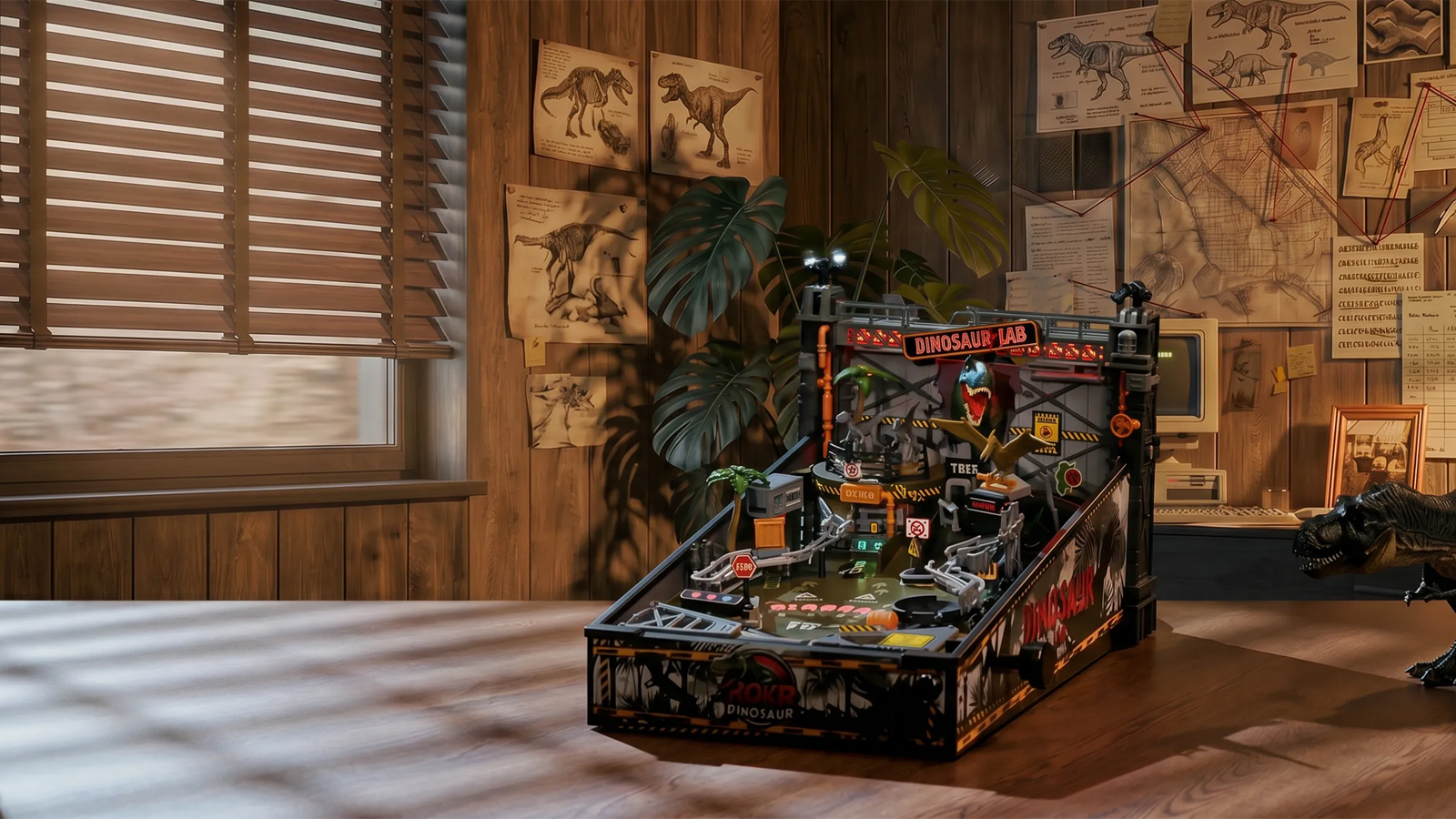
The ROKR Dinosaur Lab Pinball is a perfect complement to a dinosaur-revival or prehistoric-research narrative. Instead of creating a setup that people simply walk past and admire, it gives them something to play with inside the "lab." Visitors can interact with the machine, enjoy the dinosaur-themed pinball action, and become temporary test subjects in your highly questionable research facility. Set it on a stable table surrounded by dinosaur figures and faux fossils for a bigger effect.
Availability note: Dinosaur Lab MGP01 has completed its Kickstarter campaign and is in production. The official retail release date is still being finalized, so check the hub for the latest availability update.
If your mad scientist leans more toward alchemy, mysterious machinery, or strange energy experiments, the ROKR Alchemy City Mechanical Marble Run can fit right into the laboratory. Its moving marbles, lift, light sequences, and sound-reactive display can become your laboratory's power generator, experimental reactor, or inter-dimensional energy processor.
.jpg?w=1200&h=1200)
For more cool interactive models like these, check out our website.
The Costume
Now that the lab is ready, it is time to look like the person responsible for all of this nonsense.
An old lab coat will work wonderfully, especially if it has a few harmless stains that make it look as though you have been conducting experiments for days without sleep. It does not necessarily have to be white, either. Gray, black, or dark-colored coats can create a creepier look. A trench coat can work for a mysterious Victorian-style scientist, while a jumpsuit can make you look like someone who spends a lot of time repairing dangerous machines.
Underneath the coat, wear a button-up shirt with a bow tie. Add yellow rubber gloves and mess up your hair. A white wig is the simplest Einstein-style option; if you use a temporary hair-color product, follow its label and keep sprays away from the face and flames. Top it off with an eye patch, or push goggles up to your forehead for the just-fired-up-another-experiment look.
Whether you are wearing the costume or setting up a mannequin, the look is recognizable to many. The goal is to look like the character has been awake for 72 hours because the experiment is awfully close to changing the world.
Or destroying it.
Same thing, really.
The Effects
Adding effects will make the whole setup feel alive.
Fog can be created with dry ice in warm water, although dry ice requires more than avoiding direct skin contact. Use it only in a well-ventilated space, handle it with insulated gloves or tongs and eye protection, and never place it in a sealed or glass container. A purpose-built fog machine can provide a steadier alternative when used according to its instructions and the venue's alarm and ventilation rules.
Sound effects can completely change the atmosphere. Create a looping track with distant thunder, electrical buzzing, bubbling sounds, machinery, and the occasional evil-villain cackle.
Aside from neon lighting, a steady or slowly pulsing amber warning light can create an emergency effect that catches people by surprise in the dark.
Timed with a loud thunderclap, a single white flash can suggest lightning, and suddenly everyone knows that something in the laboratory has gone terribly wrong.
Avoid rapid strobe effects: flashing lights can trigger symptoms or seizures in photosensitive guests. Prefer steady lighting or a slow pulse, warn guests before any flash effect, and provide a route that avoids it.
Well, that was always the plan.
The Mad, Mad Fun
What makes a Halloween night memorable is not just the setup and the effects, but the fun everybody actually had. Go beyond the scary displays and invite people to play and interact.
Get into character: welcome your guests as new laboratory assistants, interns, or completely unwilling test subjects. Give them ridiculous assignments, ask them to inspect the specimens, and let them play with the interactive models. Challenge them to see who can get the best score.
As the host, be gracious, enjoy your role, and do not be stingy with the candy. A little interactive fun can turn your mad scientist laboratory from a cool-looking Halloween display into an experience people actually remember.