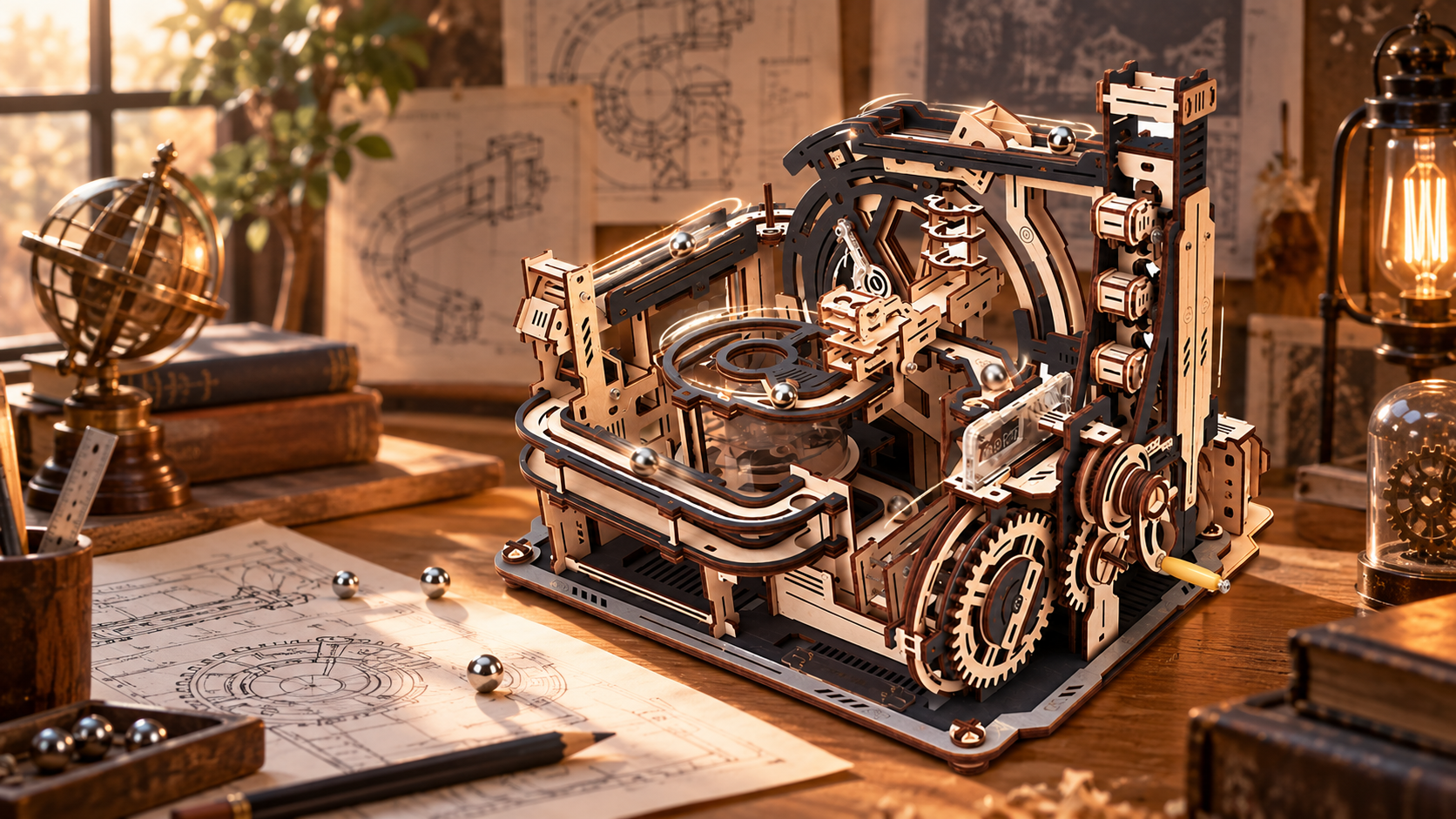
If you have ever watched a steel ball loop around a marble track without stopping, you have probably wondered what keeps it going. The answer is simpler than the model looks. A marble track trades height for speed, and the clever part is the shape of the path.
Gravity pulls the ball down a channel, the walls steer it, and on models built to loop, a lift carries it back to the top. Once you can see those parts at work, you will know where to look when your run stalls.
Here is a detailed breakdown of the mechanism behind marble tracks.
The Simple Physics Behind Marble Tracks
Every marble track leans on the same few principles, and spotting them at work makes a stubborn model easier to fix.
Gravity Gives the Ball Its Energy
When you raise a ball to the top of the run, you store potential energy in it. Let it go and that energy turns into motion, with a steeper slope converting it faster. Some of it goes into spinning the ball, so it speeds up slower than a sliding object would.
Ball Weight and Diameter
ROKR marble runs are designed around the supplied steel balls, whose diameter, mass, and smooth surface are matched to the track and mechanisms. Using a ball of a different size can affect clearance at track joints, lifts, and diverters.
Friction and Surface Smoothness
Friction works both ways here. You need a little so the ball rolls instead of skidding, and as little as possible everywhere else.
A burr on a laser-cut wooden edge can interfere with fit or movement and should be removed with sandpaper or a file. For moving parts such as gears and sliders, a small amount of wax can help reduce friction.
Track Fit and Alignment
Where two marble track pieces meet, even a tiny step becomes a speed bump. If one sits a fraction proud of the next, the ball clips that lip and can hop out of the channel. Precision cut parts handle most of this, but seating each joint fully is still your job.
The Core Mechanisms of a Recirculating Marble Track
Not every marble run has all of these. Plenty are simple gravity runs, where you drop a ball in and collect it at the bottom. These parts turn that one way trip into a loop.
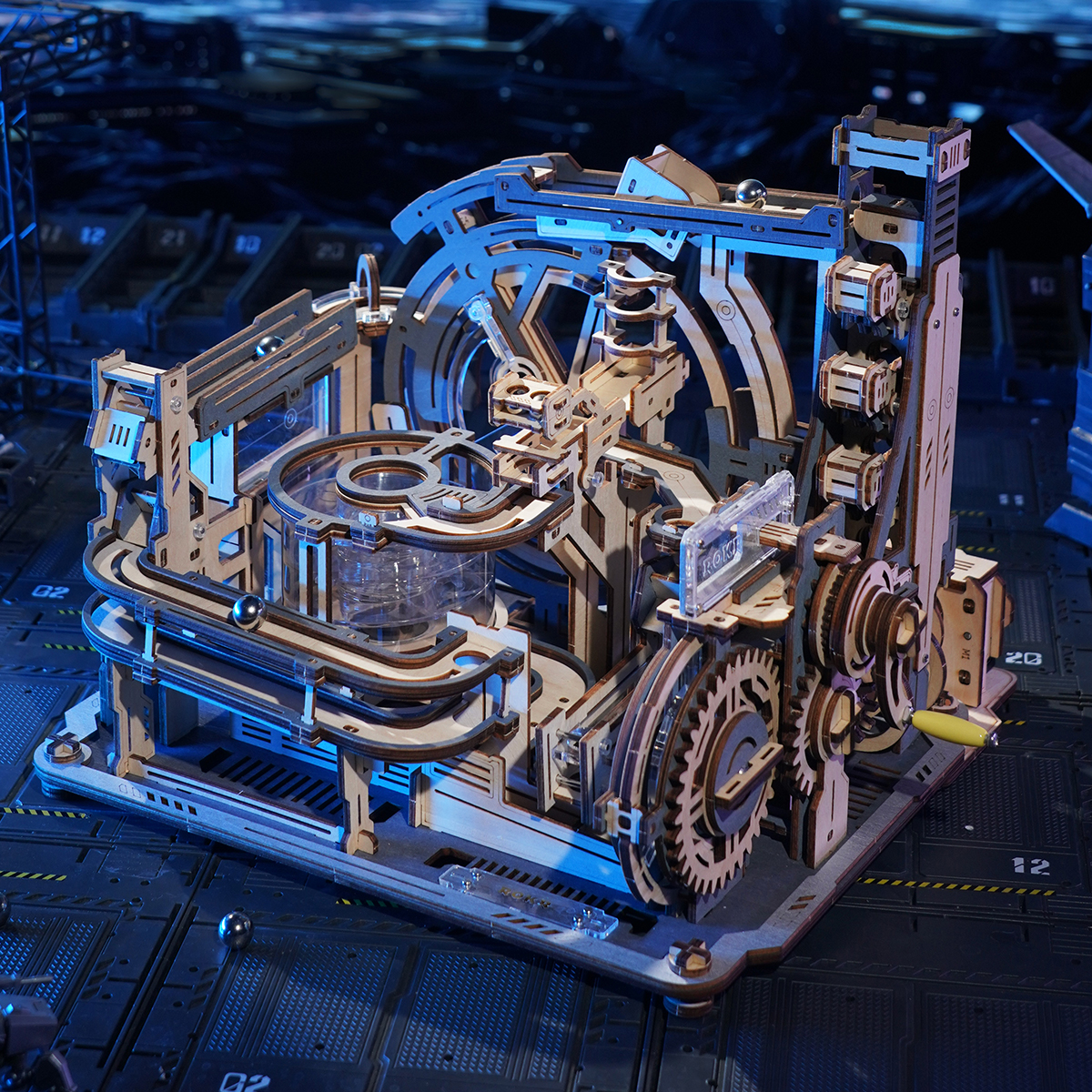
- The lift. This raises the ball back to the top, restoring the gravitational potential energy it loses on the way down. The energy comes from a hand crank, motor, or another external drive. Bucket lifts, wheel lifters, and stair style lifters all raise balls to the top.
- The distributor. Sitting near the top, it can direct balls toward different routes. For instance, the ROKR Marble Spaceport uses diversion mechanisms across five layered tracks.
- The tracks. Slopes, spirals, funnels, and acceleration sections shape the descent. Even the simplest run has these.
- The diverters. Switches, seesaws, and separator wheels split the flow partway down. Not every model has them, but they are what stops each lap looking the same.
- The return channel. A collecting track at the bottom feeds every ball back to the lift, closing the loop.
- The gear train. Gears link your crank or motor to the lift and set the pace.
Hand Crank vs. Electric Motor: How the Ball Returns to the Top
Lifting the ball is the one job gravity cannot do for you, so any model built to loop needs a power source. ROKR answers that in a few ways.
Marble Night City runs on a hand crank alone, with no electricity involved. You turn the handle, the gears drive the lifter, and steel balls return to the upper tracks. Since you set the pace, you can send up one ball or a steady stream.
Marble Spaceport gives you both options. Turn the handle for hands on control, or let the motor run it through six diversion mechanisms and five layered tracks. In electric mode, it runs from a USB power connection; a Type-C cable is not included.
The Parallel World models use a powered lift to keep the balls circulating, with lighting effects following along.
Why Precision Matters and How to Keep It Running
Marble runs are unforgiving of small errors because every lap repeats the same mistake.
ROKR parts use a press fit, so your model holds together without glue. That keeps it serviceable. If a piece is not fully seated, however, it can affect the alignment of the track or mechanism. Pressing each joint fully home as you go saves you fault finding later.
Wax is another habit worth picking up, and you will find gears, sliders, and contact points much easier to reach before the mechanism is enclosed.
When a ball stops, the cause is usually a gear out of alignment, a track joint with a lip, or friction in an unwaxed moving part. The ROKR Building Tips & Tutorials page covers the fixes.
Check Out the Complete Marble Run Collection
A marble track works because three things happen in order. Gravity moves the ball down, the track controls where it goes, and if your model loops, a lift returns it to the top.
Everything else is a variation on that idea, and you can see how differently it plays out across the Marble Run collection.
FAQs
What is the difference between a marble track and a marble run?
People use marble track and marble run interchangeably, but there is a useful distinction. A track is the pathway itself, the channel the ball travels along. A run is the whole system, which on a looping model includes the lift and the return channel.
Why does my marble fall off the track?
Most of the time, a joint is not fully seated, so the ball meets a small step and bounces out. It helps to check just above the spot where it leaves, since the trouble often starts higher up. A flat surface helps too, since flexing panels shift the angle.
Do marble runs need batteries?
Hand-cranked models, such as Marble Night City, need no power at all, since your hand is the motor. Marble Spaceport can use its electric drive through a USB power connection, and its Type-C cable is not included.
Why does my run stop halfway?
A run stopping halfway usually points to friction or a jam. Common culprits include an unwaxed gear, a ball wedged at a diverter, or dust in a channel. Also check whether the lift engages correctly and whether the ball enters each transfer point cleanly.