
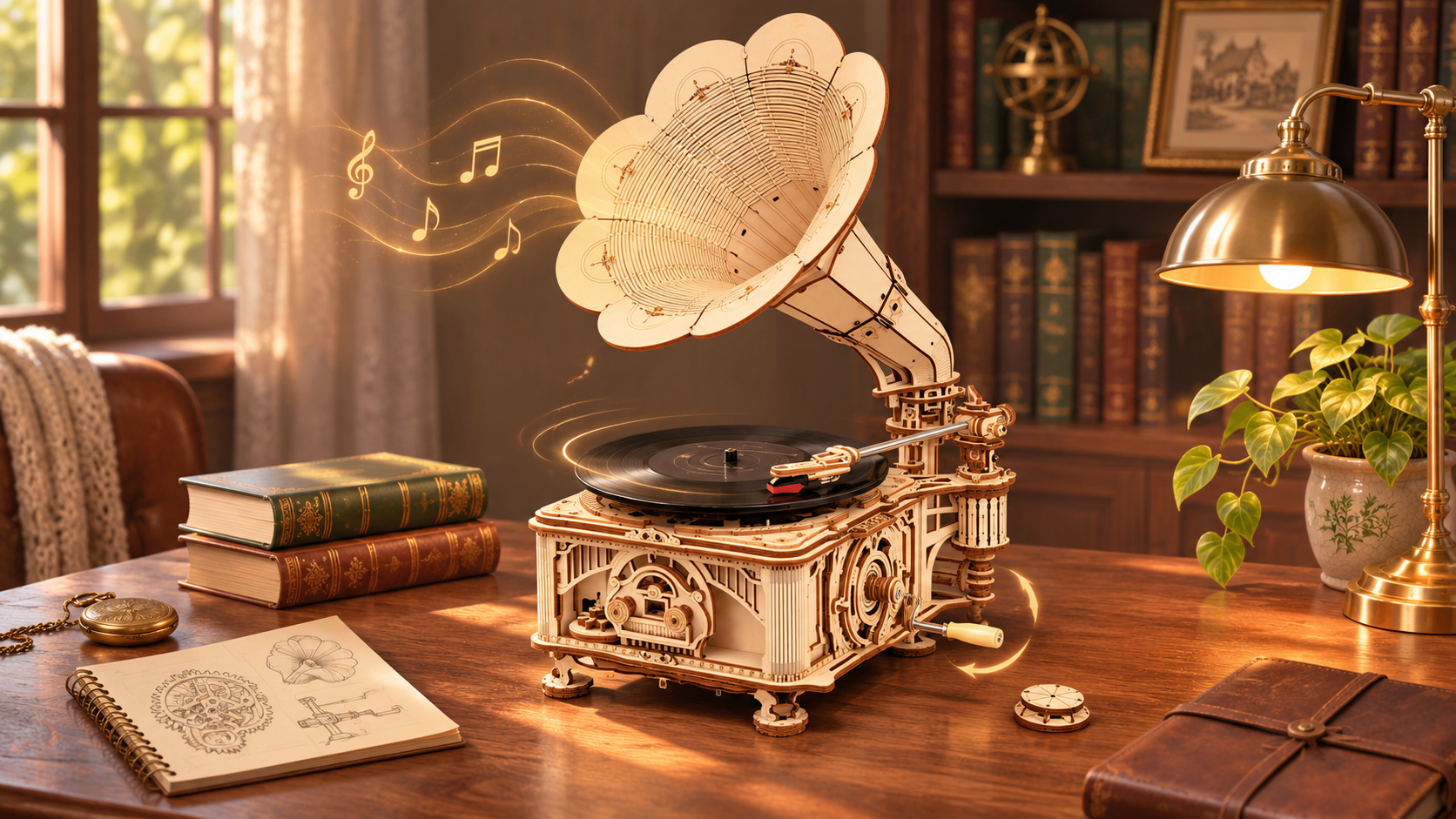
The gramophone helped turn recorded music into something people could buy, take home, and play again. Before recorded sound, people mainly heard music by attending live performances or making it themselves.
The device helped pave the way for how we listen today. What sets the acoustic gramophone apart is that it played music without electricity or electronic speakers: a hand crank or wound spring turned the disc, while a stylus, diaphragm, and horn turned its groove into audible sound.
Let’s explore this ingenious invention and find out how the beloved device still symbolizes music and the birth of the recorded music industry today.
Giving Sound a Shape
In 1877, Thomas Edison introduced the phonograph, a hand-cranked tabletop machine built around a tinfoil-wrapped metal cylinder. Sound moved a thin diaphragm, and the stylus attached to it pressed an impression into the foil.
Edison envisioned the phonograph as a tool for dictating letters and preserving voices. By 1878, he had also proposed using it to reproduce music. Later, people paid a nickel to hear recordings on coin-operated phonographs.
Emile Berliner developed the gramophone and obtained a patent in 1887. His gramophone used flat discs rather than cylinders, making it easier to press copies of a recording.
Thus, the gramophone turned recorded sound into an everyday household product.
Why It Didn’t Go Electric
Household electricity was not yet widespread in the late 1800s.
Edison’s early phonograph and Berliner’s acoustic gramophone could both play back recordings using mechanical power.
The Mechanism
Edison’s phonograph captured sound with a horn or mouthpiece, a thin diaphragm, and a stylus. When someone spoke or sang into the mouthpiece, the sound waves made the diaphragm vibrate. The attached stylus pressed those vibrations into the foil on a cylinder turned by a hand crank. Playback reversed the process: the stylus followed the recorded indentations, the diaphragm vibrated, and a horn or listening tube carried the sound to the listener.
Berliner’s Gramophone
Berliner’s gramophone played flat discs and relied on a chain of precisely coordinated parts. Together, they kept the record turning and reproduced the sound recorded in its groove.
The Spring Motor
Acoustic gramophones did not need electricity, but they still needed a source of energy. Berliner’s earliest machines in the late 1880s and early 1890s drew it directly from the person playing, who turned the disc with a hand crank. This worked, but it was hard to keep the speed steady, and the pitch changed whenever the cranking speed varied.
In 1896, engineer Eldridge Johnson helped adapt Berliner’s gramophone to use a spring motor. Spring-driven playback soon became common on acoustic machines. Winding the spring stores mechanical energy, which it releases to turn the record during playback.
The Governor
The spring drives the mechanism as it unwinds. The governor acts like a built-in brake, adding resistance when the mechanism starts to run too fast.
In a typical centrifugal governor, the spring motor spins a shaft through gears. As the shaft spins faster, small weights move outward and push a collar against a friction pad, slowing the shaft. As it slows, the weights move back inward and the brake eases off.
This helped keep the record turning at a steady pace.
Enter Comedy: When the Record Doesn’t Spin Right
Consistent rotational speed matters because changes in speed affect pitch. Too fast, and the stylus vibrates quicker than intended, giving a hurried, chipmunk-like voice. Too slow, and the music drags into a low, slowed-down drawl.
The Turntable and the Record
In a wind-up gramophone, the spring drives the turntable, and the turntable carries the record. The sound is stored as a physical shape in the disc’s surface.
On Edison’s cylinder, the depth of the groove varied. On Berliner’s flat disc, the groove moved from side to side. Berliner experimented with zinc discs, and early pressings used materials such as hard rubber and shellac. Vinyl records became common much later.
The Stylus
The stylus rests in the record groove and follows it. As the record rotates, variations in the groove cause the stylus to vibrate. The stylus transmits those vibrations through a small linkage to the diaphragm in the soundbox.
The Soundbox
The soundbox contains a thin diaphragm that vibrates in response to the stylus and creates sound waves in the air. It’s considered the heart of the gramophone.
The Horn
In a typical acoustic gramophone, sound waves from the diaphragm pass through the hollow tonearm into the horn, which helps project the sound into the room. Since there’s no electricity involved, the device uses mechanical vibration and acoustic design to make the recorded sound audible, which is why the soundbox and horn are integral parts of the design.

The Flow: How an Acoustic Gramophone Reproduces Sound
On an early hand-driven machine, the crank turns the disc directly. On a wind-up model, the crank winds a spring, which turns the disc after winding. From there, the path from groove to sound is the same.
- Mechanical energy: A hand crank or a wound spring supplies the motion.
- Record rotation: The turntable moves the groove past the stylus.
- Stylus follows the groove: Side-to-side variations make the stylus vibrate.
- Soundbox diaphragm vibrates: The diaphragm moves the air to produce sound waves.
- Horn radiates sound: The flared horn helps project the sound into the room.
From Berliner’s Gramophone to Today’s Turntables
Engineers later used electricity to drive the turntable and to reproduce the sound. These were separate changes: the motor turns the record, while the pickup and amplifier handle the audio.
An acoustic gramophone has an intimate character shaped by its horn, with a narrower frequency range and a distinctly vintage tone. A modern record player still has a stylus that follows a groove. Instead of a soundbox and horn, a cartridge converts the stylus’s vibration into a tiny electrical signal. An amplifier boosts that signal, and speakers turn it into sound.
The difference is audible. A modern playback system can reproduce a wider range of frequencies and gives listeners more control over volume.
In the 1920s, record makers began recording with microphones and electrical equipment. Many homes still played these records on wind-up acoustic gramophones, while others began adding electric motors and electric pickups, which paved the way for the record players we know today. Even acoustic machines of the period were redesigned using lessons from electrical engineering.
Why ROKR Is Commemorating the Gramophone
ROKR has come up with a few gramophone-inspired 3D mechanical puzzles for everyone to enjoy and appreciate Berliner’s design.
Why? Because the acoustic gramophone remains a hands-on demonstration of how sound physically works. ROKR’s kits let you build models inspired by that design.
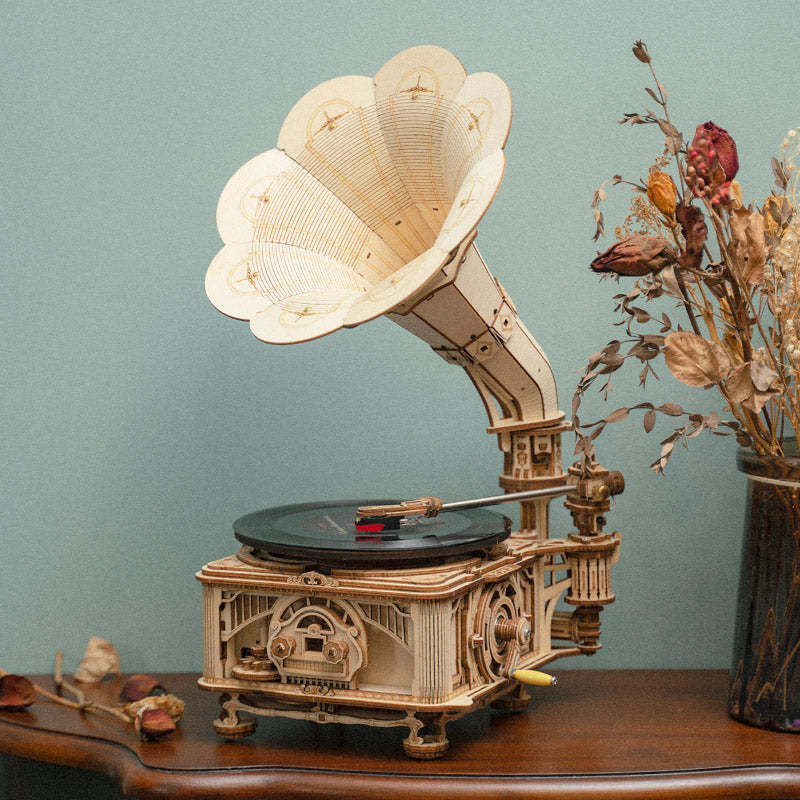
The ROKR Classic Gramophone LKB01 is a hand-cranked model that plays compatible 7-inch and 10-inch records. The Classic Gramophone LKB01D supports both hand-cranked and powered turntable operation.
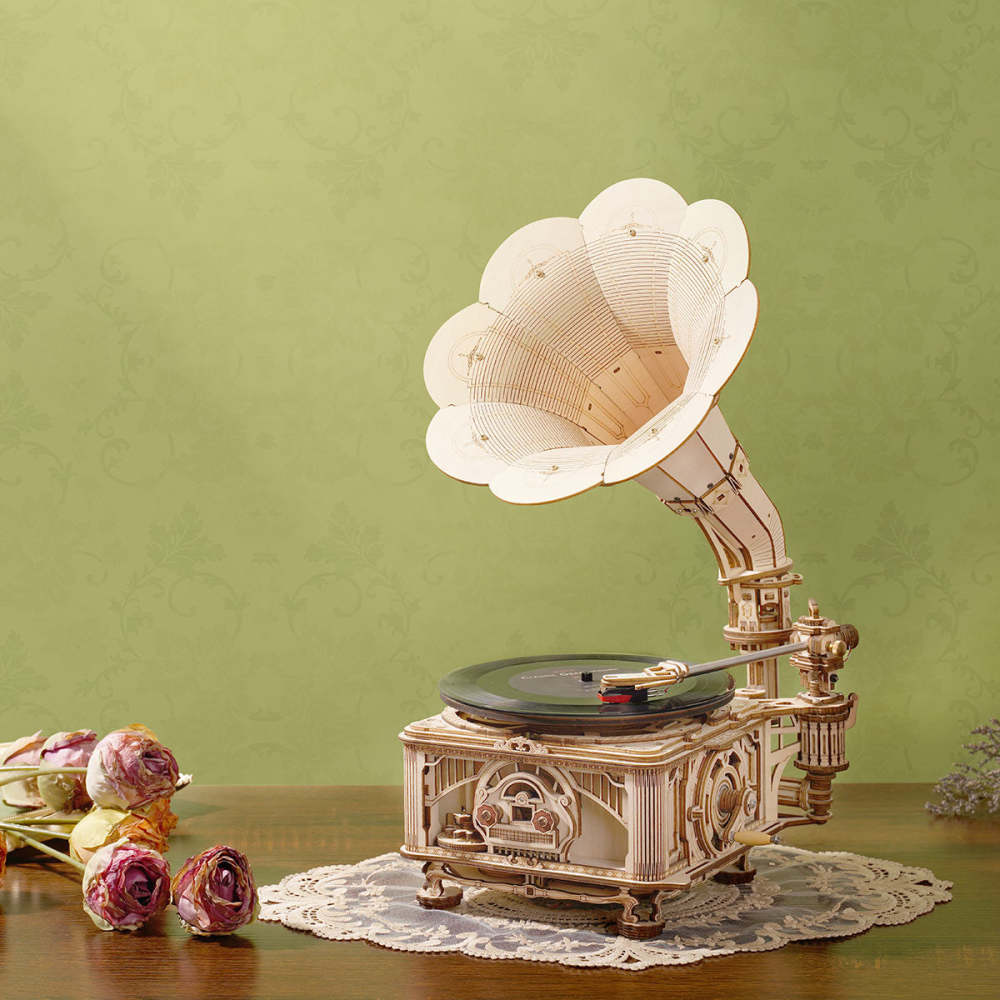
The Diva Gramophone AMK82 is a gramophone-inspired mechanical music box with a transparent acrylic disc, hand crank, and horn-shaped design.

Worth Winding Up For
The gramophone helped bring recorded music into more homes.
What did both Edison and Berliner accomplish? They gave sound a shape that could be kept, copied, and played again at home, proving that recording and playback were possible without electricity. A wound spring, a groove, a soundbox, and a horn could put recorded sound in homes without a power line. Modern turntables still follow one part of that path: a stylus traces a groove, and its tiny movements become sound.
This was the beginning of the recorded music industry. To try a piece of that history for yourself, give the crank a turn on a ROKR gramophone you assembled yourself.