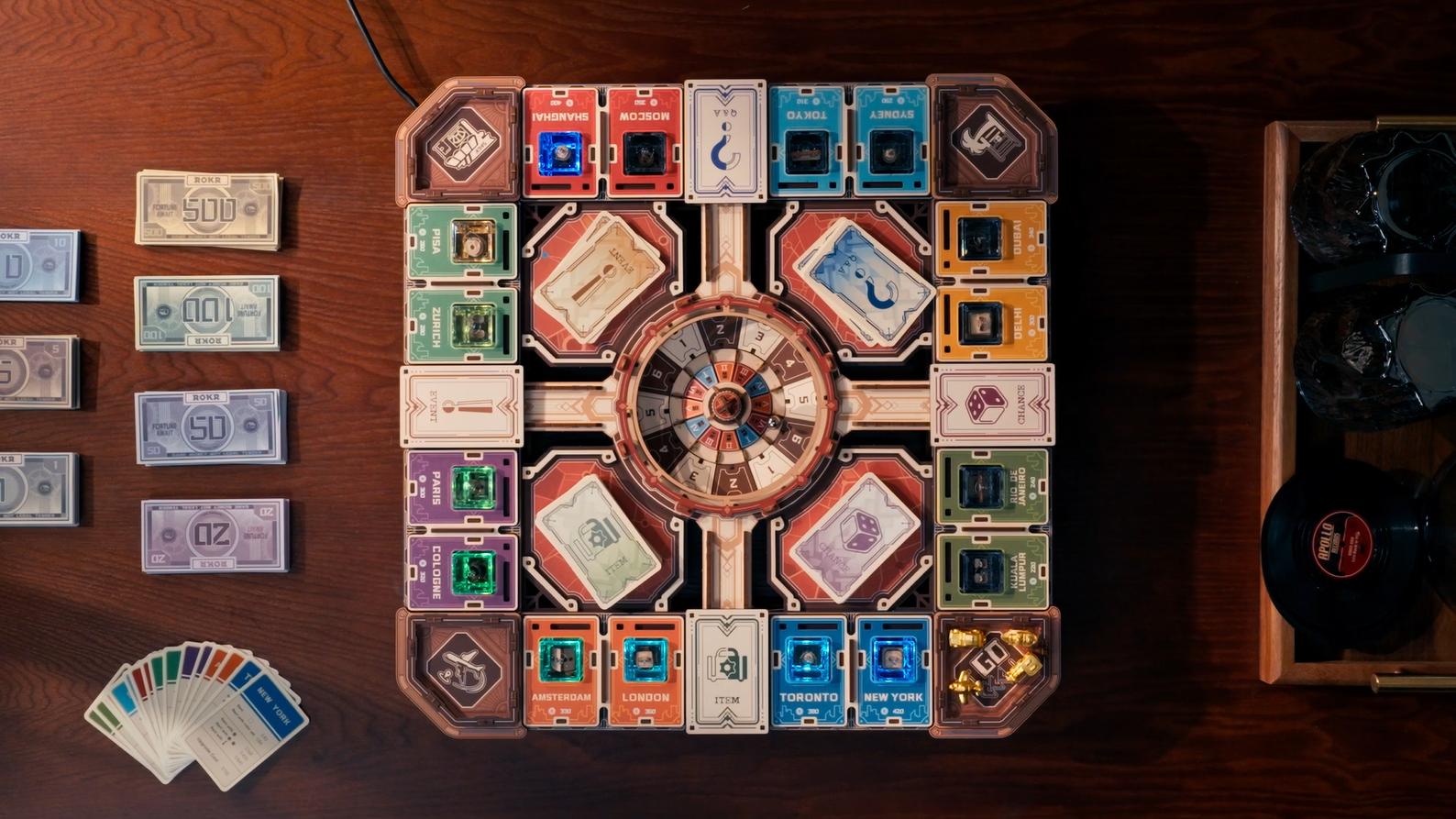
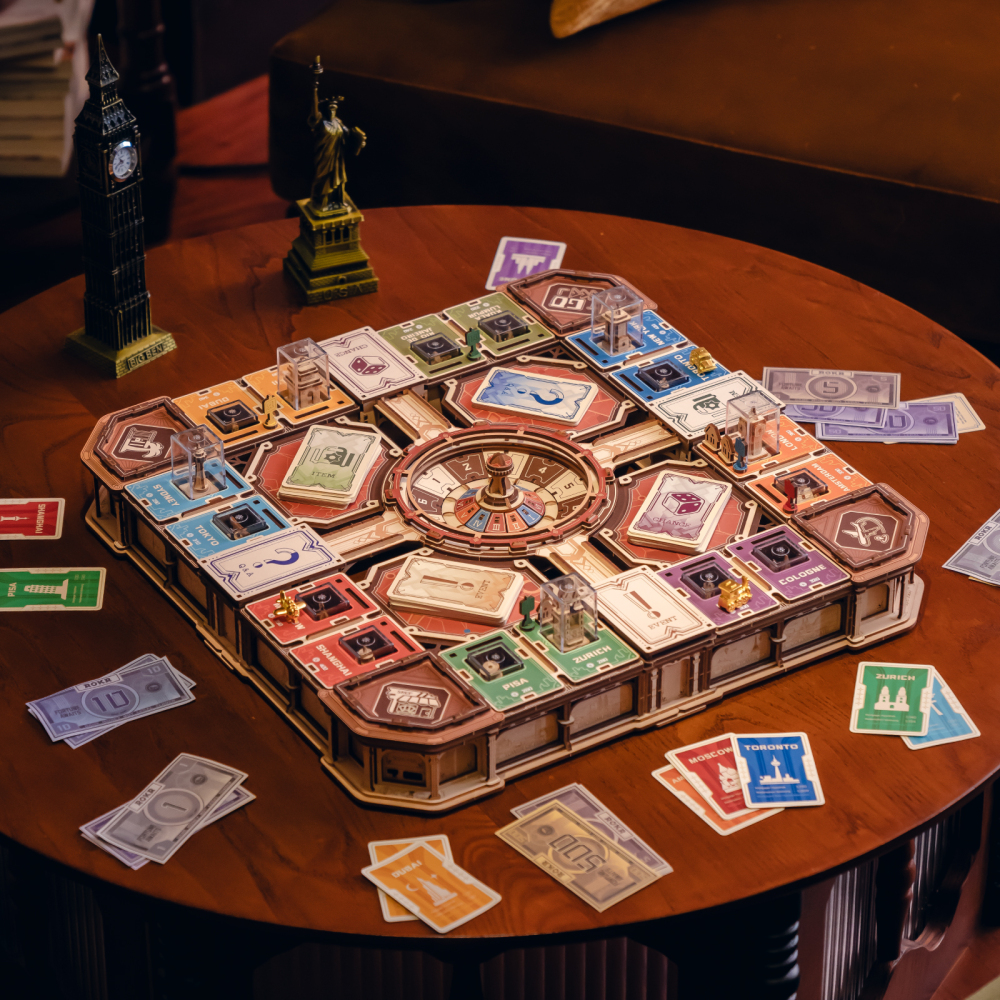
A steel marble circles the center of the board. Everyone waits for it to settle, then one player moves toward a property, a card space, or a rent payment they would rather avoid. Around the edges, colored flags mark ownership and landmark buildings turn a flat route into a three-dimensional property game.
Before that first turn, there is another project to enjoy: making the board itself. ROKR Fortune Quest EGM01 is a 907-piece 3D wooden puzzle that becomes a playable multiplayer board game after assembly. The finished model is not just something to admire between builds. It is the setting for property purchases, auctions, development decisions, and the next round with friends.
That combination gives Fortune Quest two distinct experiences: a substantial hands-on build, followed by a game in which the people around the table decide what happens next.
A Board Game That Starts at the Workbench
Allow about eight hours for assembly, with the option to spread the work across several sessions. Fortune Quest is rated for ages 14 and up, and its 907-piece construction makes it a project to plan for rather than something to open immediately before guests arrive.
The completed board measures 400 x 400 x 80 mm, or approximately 15.7 x 15.7 x 3.1 inches. Leave extra table space around that footprint for cards, money, and the players' hands. A clear working area is useful during assembly; a shared tabletop becomes important once the game begins.
Although it is a 3D wooden puzzle, Fortune Quest does not consist entirely of wooden parts. Its construction combines laser-cut and injection-molded components, while the game pieces are made from zinc alloy. The result brings model assembly and board-game handling into the same object.
The appeal is especially clear for someone who enjoys finishing a model but also wants a reason to take it off the shelf. Here, completing the build is preparation for another activity, not the end of the experience.
How Many People Can Play Fortune Quest?
Fortune Quest is designed for 2-5 participants, with an important distinction: up to four players move pieces on the board, while an optional fifth participant can serve as referee.
There are four player colors and matching flag colors: red, yellow, blue, and green. The fifth role is not an additional color or a fifth moving piece. For a gathering of five, that person participates by taking the referee role described in the game guide.
This makes it worth thinking about who will assemble the kit and who will join the finished game. The builder does not need every future player present during construction, but everyone should have time to become familiar with the included rules before the first round.
Spin the Marble, Then Make Your Move
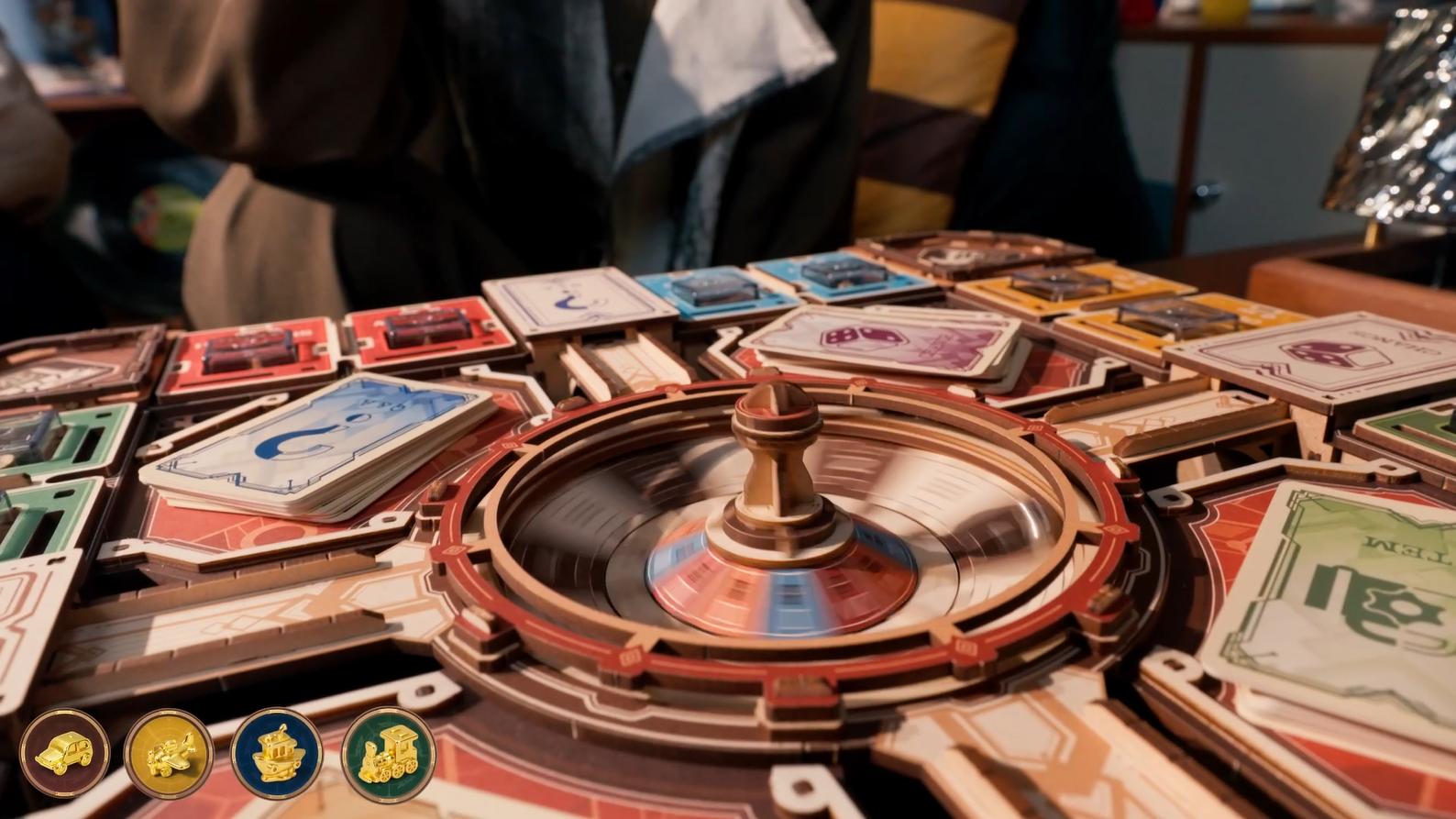
The integrated marble spinner sits at the center of Fortune Quest. Instead of rolling dice, a player manually spins the central unit and watches a steel marble travel around it. When the marble stops at a numbered position, that number determines how many spaces the player's piece moves around the board's perimeter.
The spinner gives each turn a shared moment of anticipation. Movement comes from where the marble settles; the decisions begin when the player reaches the next space.
The basic sequence is straightforward:
- Spin the central marble spinner and wait for the steel marble to stop.
- Move your piece the number of spaces shown.
- Resolve the space you reach, whether it involves property, a card, or another game rule.
- Make any purchase, bid, payment, or development decision that applies under the rules.
For example, a result of one moves a piece one space. If that space is Chance, the player draws and resolves the corresponding card. A later move might lead to a location such as Zurich, where what happens depends on ownership and the game rules.
This is an introduction to the turn structure, not a replacement for the illustrated game guide. Keep the full rules nearby for special spaces, payments, and situations that need a closer check.
Buying a Property Is Only the Beginning
Landing on an unowned property creates a choice. The current player may purchase it at the listed price. If they choose not to buy, the property enters an open auction in which eligible players can bid.
That auction changes the conversation around the table. A property one person passes over may matter to someone else, particularly if it helps complete a matching-color group. Passing on a purchase does not simply remove the property from consideration.
Ownership also affects later turns. A player who lands on someone else's property must pay rent according to the rules. Money needs to cover more than the next purchase: it also supports auction bids, rent payments, penalties, and development.
Fortune Quest includes 210 money cards for that in-game economy. Choosing where to spend and what to keep in reserve is part of the property strategy. The attraction is the competition within the game, whether a player prefers collecting properties, bidding for a missing piece of a color group, or investing in what they already own.
From Color Groups to Landmark Upgrades
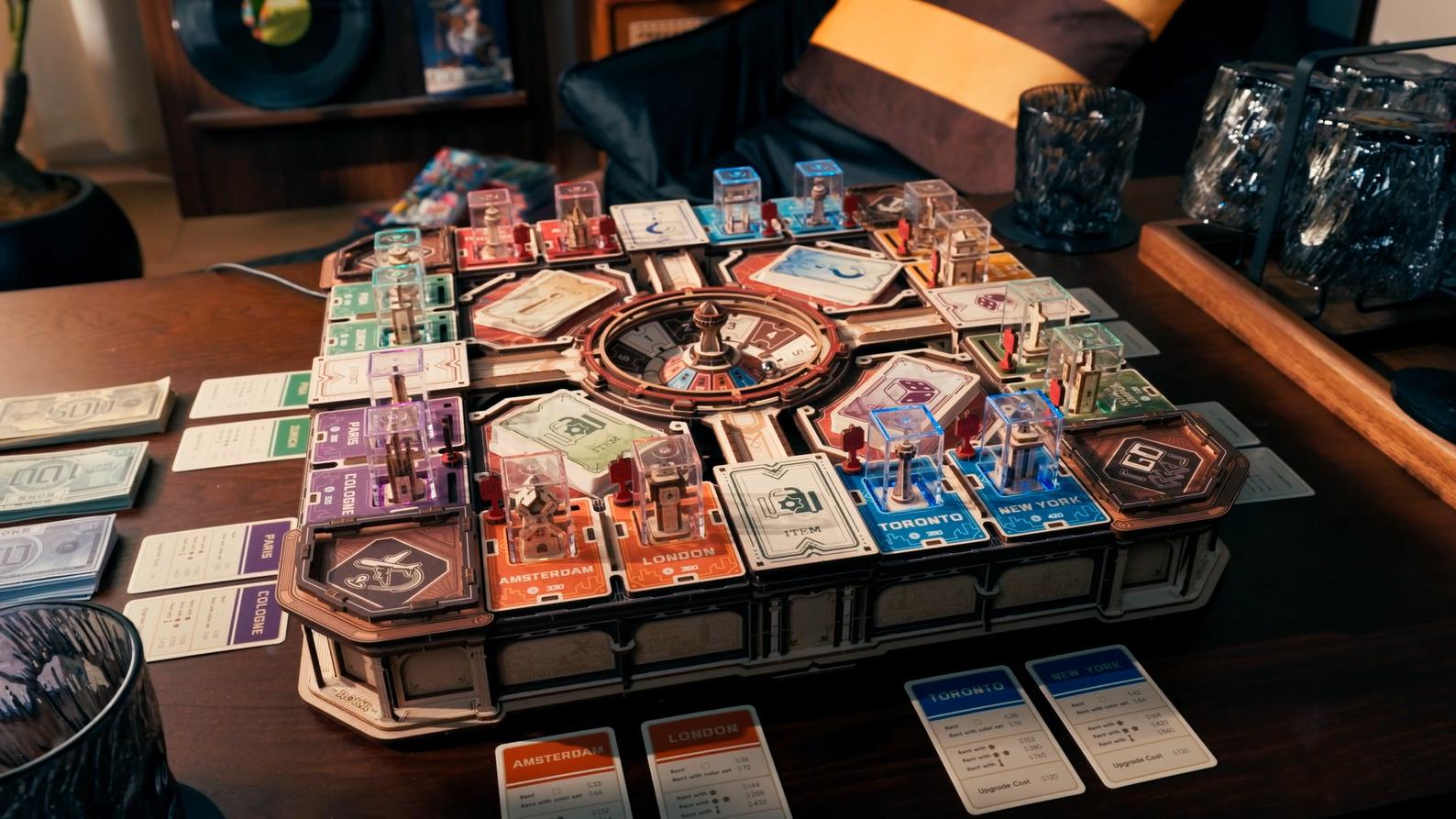
Collecting a full matching-color property group opens up development. Players can invest in houses and eventually upgrade developed properties into landmark buildings, increasing their potential rent.
Fortune Quest includes 16 iconic landmarks, so development changes more than an ownership record. It also changes the three-dimensional scene on the board. The properties players have worked toward become part of the model's visible structure.
The press-based interaction, called Press to Elevate, lets players activate, expand, or downgrade the relevant structures. At the final upgrade stage, light and sound effects add feedback to the progression. The interaction is hands-on: players press the mechanism as part of the property and landmark experience.
This is where the build and the game connect most directly. The structures assembled before play become things players interact with as their position develops. The board remains a wooden model, but it is also a changing setting for the competition.
Cards Give the Next Turn a Different Direction
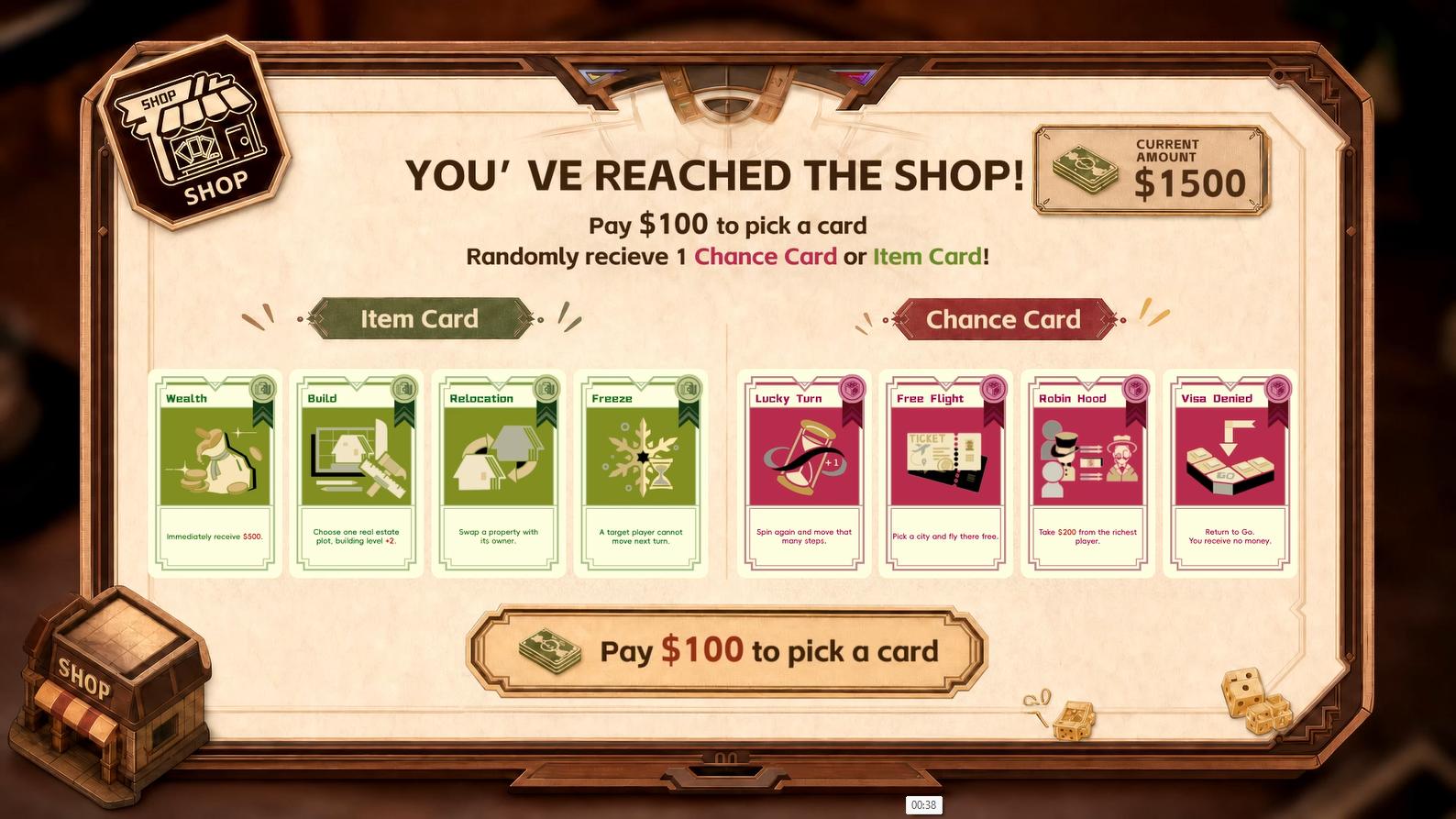
Properties are only part of the route. Fortune Quest includes 92 colorful cards across four confirmed categories: Chance, Fate, Item, and Question. Events can bring bonuses, penalties, special items, forced movement, or other changes defined by the rules.
These cards interrupt a plan that might otherwise seem predictable. A player setting money aside for development may face a penalty; another may receive a bonus or an item that changes the next decision. The card drawn and its instructions determine the outcome.
Start and Jail are also part of the board. Passing Start can provide salary under the game rules, while Jail follows its own rule in the guide. Rather than importing assumptions from another property game, use Fortune Quest's included instructions to resolve each space.
The mix of numbered movement, property choices, and card events gives players something to respond to even when they know the board. Owning a useful property group does not make every later turn predictable.
Is Fortune Quest the Right Build-and-Play Gift?
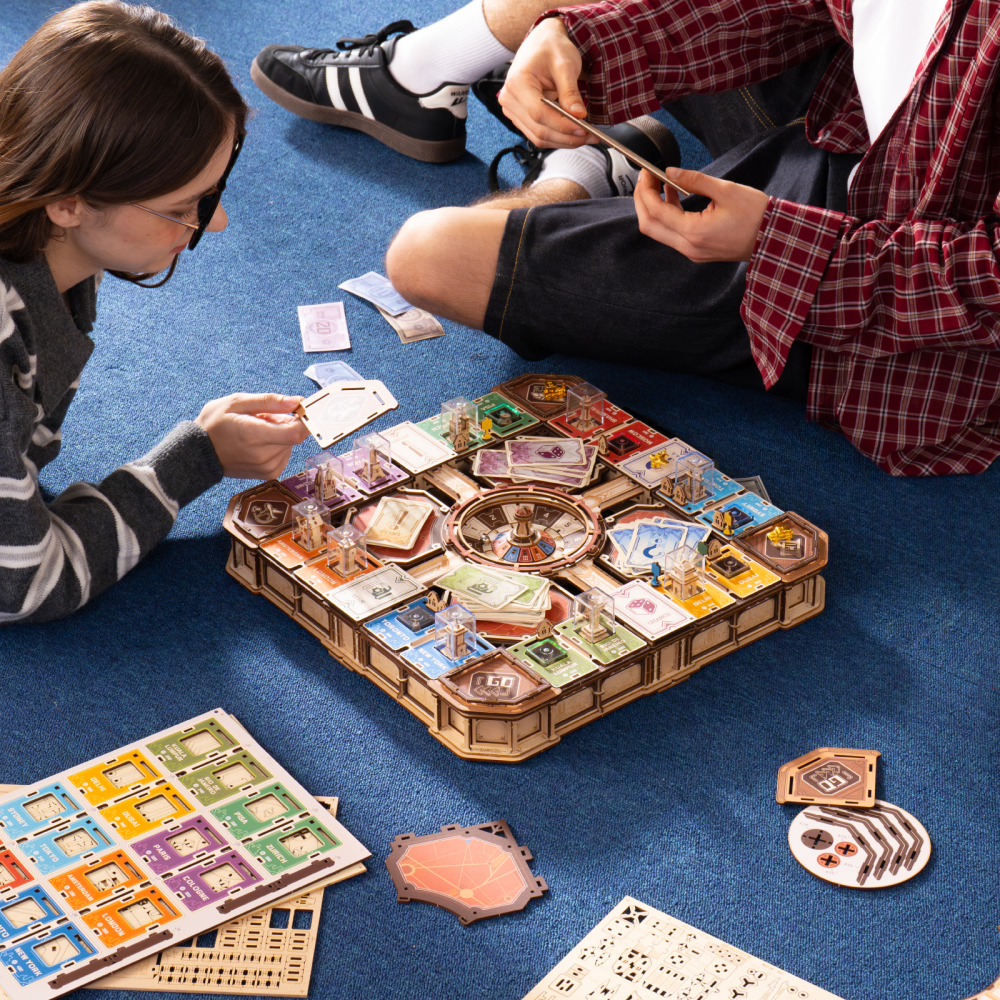
Fortune Quest makes the most sense for a recipient who likes both a sustained assembly project and a competitive tabletop game. It also suits a model builder who wants the finished piece to become part of time spent with friends or family members aged 14 and up.
Before choosing it, consider three practical questions:
- Does the recipient want a long build? About eight hours is the assembly reference, not the length of a game session.
- Will the finished board have room to be played? The 40 cm square model needs additional space for cards, money, and participants.
- Does the group enjoy property strategy? Buying, auctions, rent, development, and unexpected events are central to the experience.
The light and sound features are battery-powered. Check the supplied instructions for the required batteries and setup before the first game. The illustrated game guide and full rules are included, so there is a reference for the parts of play that a quick overview cannot cover.
For someone mainly looking for a small display piece or an activity ready to play straight from the box, a different project may be a better fit. Fortune Quest asks for time before the first turn, and that making stage is a large part of its appeal.
For a wider look at what happens after assembly, see ROKR's guide to DIY models you can build and play with.
The Build Finishes. The Game Begins.
Many model kits earn their place through the finished object. Fortune Quest adds a shared use for it: friends gather around a board you assembled, follow the marble's movement, bid on properties, and watch landmarks become part of their plans.
The details work together because they belong to the same experience. The spinner starts a turn, the flags make ownership visible, the money and cards shape choices, and the press-based structures give property development a physical form.
Explore ROKR Fortune Quest EGM01 for the current product details. If the build-and-play idea is what appeals to you, ROKR's Amusing Table Game collection offers a broader place to explore interactive tabletop projects.