

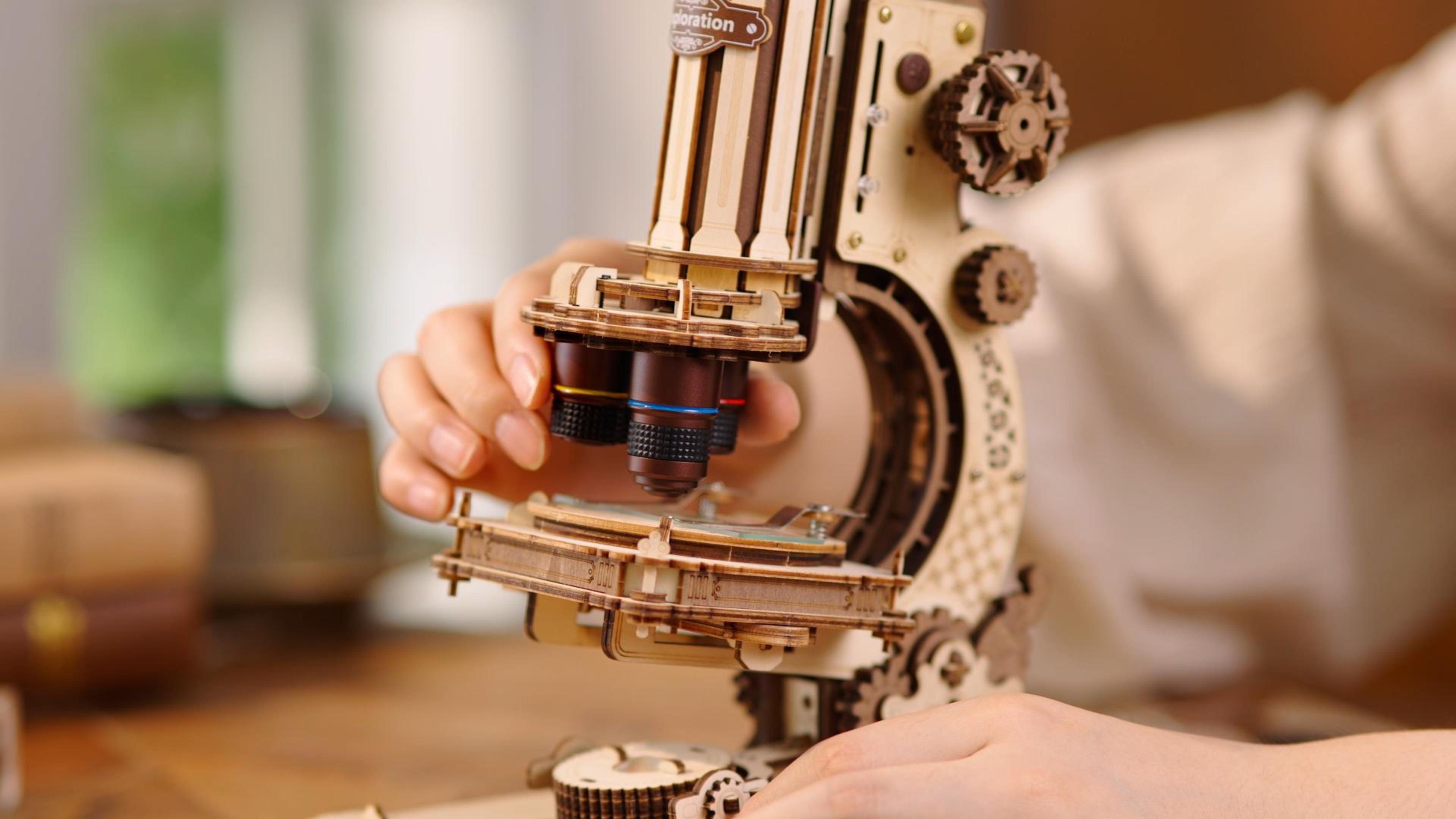
Would you rather learn from a book or from an actual tool you can build and use? Coming back to school as a STEM learner should be exciting and not dreadful, so here's an awesome project that's highly engaging and enriching without feeling like a classroom lecture.
This is the ROKR Microscope ST005, from which you can easily learn and retain important STEM concepts through hands-on practice.
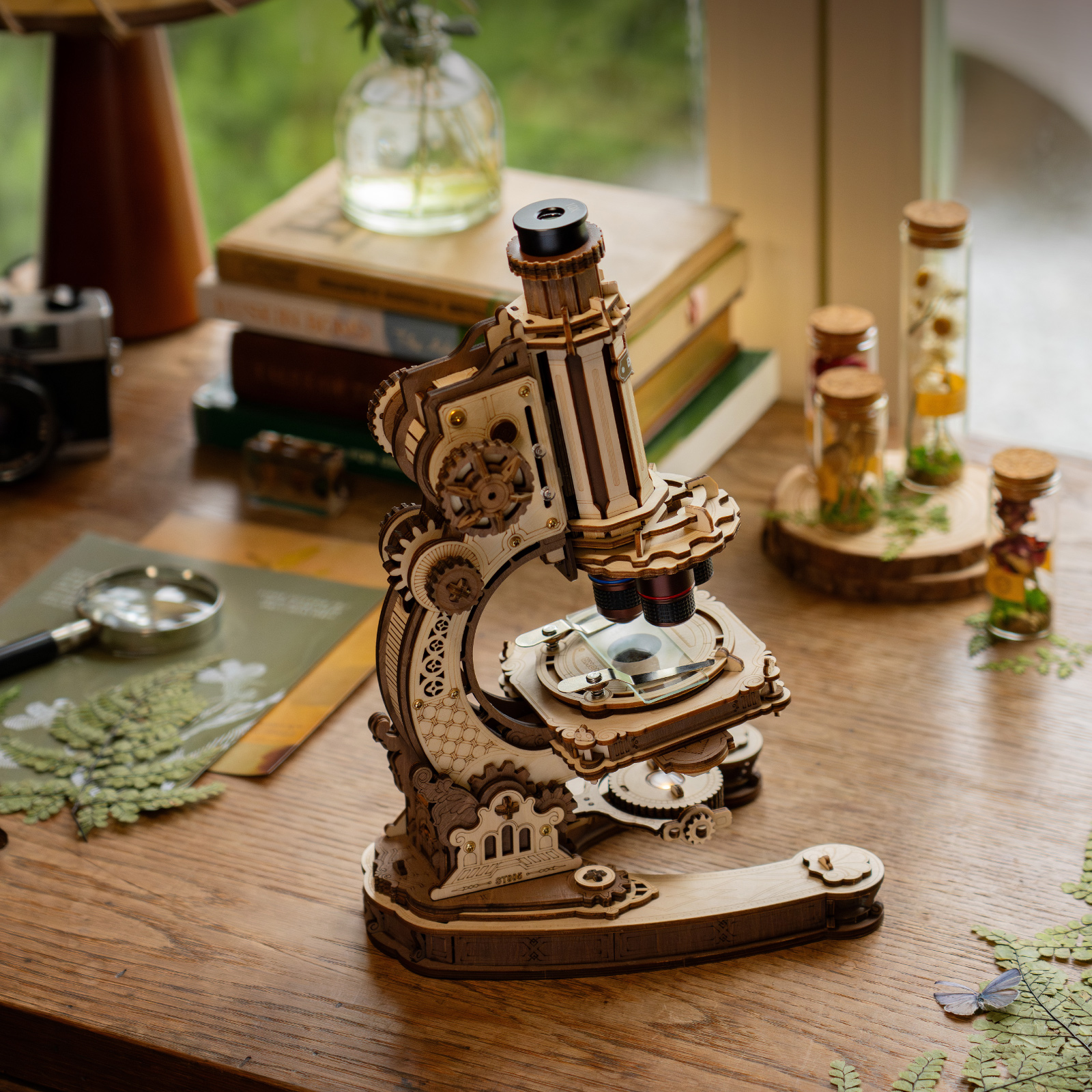
Why Hands-On Learning Sticks
STEM concepts are just abstract ideas that remain, well, abstract, unless they're applied. Books and lectures are helpful, but understanding and memory retention come when your senses are engaged.
With projects like the ROKR Microscope ST005, you're not spoon-fed lessons from a page, but rather, you have free rein to take the concept, test it in different ways, and observe the results as they happen in real time. You gain muscle memory from manipulating samples, and practice critical thinking through active problem-solving.
Case in point: you've read about pathogens and microorganisms from a biology book. But when you observe a drop of pond water from under the ROKR Microscope, you go, "I can't believe there are so many of them, and that I saw them moving!"
Additionally, those eureka moments that trigger a satisfying feeling of reward make the lessons even more memorable. They come from the satisfying click of putting the last piece on the model, as well as with each discovery made upon peeking through the lens of the ROKR Microscope.
Why is retaining STEM concepts important?
Beyond schooling, these concepts have real-world applications. For example, the principle of mechanical advantage encompasses everything from car jacks to construction cranes to the gear systems in household appliances. Optics shows up in cameras, eyeglasses, telescopes, and medical imaging. The scientific method of observing, hypothesizing, and testing is the basic operating procedure not just for every technical and scientific career, but for everyday problem-solving as well.
Aren't we all glad that ROKR models don't just teach everyday STEM concepts, but do it in a fun, hands-on, and exciting way?
How to Operate the ROKR Microscope ST005
Let's get to learning and playing! Once the build is finished, you only have to follow a simple routine to use the Microscope.
- Power it on. Load two AAA batteries and switch on the built-in LED. This lights the specimen stage.
- Load a sample. The kit already comes with a slide, a pair of plastic tweezers, and a cover slip. Take a slide, place a sample carefully in the middle, and place a drop of water on it. Use the cover slip to secure the sample in place. Then place the slide on the Microscope's stage, securing it with the metal clips, just like a real lab microscope.
- Choose a lens. Rotate the nosepiece to select 40x (wider view), 100x, or 400x magnification.
- Focus. Turn the knob to raise or lower the lens barrel.
- Adjust for contrast. Switch between the green and blue filters to change how light passes through the sample, sharpening detail on structures that are otherwise hard to see clearly.
- Observe and compare. Try different magnifications and filters and notice the changes in the image as you adjust.
Enjoy playing with different samples as you pick up important STEM principles along the way.
Lessons in Engineering
As a ROKR model, the Microscope ST005 teaches mechanical principles to builders mainly through its worm-and-worm gear mechanism. Each turn of the adjustment knob is converted by the gear teeth into a precise 4.5 mm vertical motion, raising the lens barrel to adjust the microscope's focus.
Each turn of the knob also creates an audible click generated by a spring-tab system hidden inside the gear assembly.
How a STEM learner understands this is through tooth-by-tooth assembly, emphasizing the importance of gear ratios in creating smooth motion. Since ROKR models don't require glue, parts can be taken apart and rebuilt if you need correction or a repeat demonstration.
Lessons in Optics
The ROKR Microscope helps learners understand magnification through 3 interchangeable lenses on a revolving nosepiece. Delivering 40x, 100x, and 400x magnification, these lenses can also be contrasted by blue and green filters available on the sliding diaphragm.
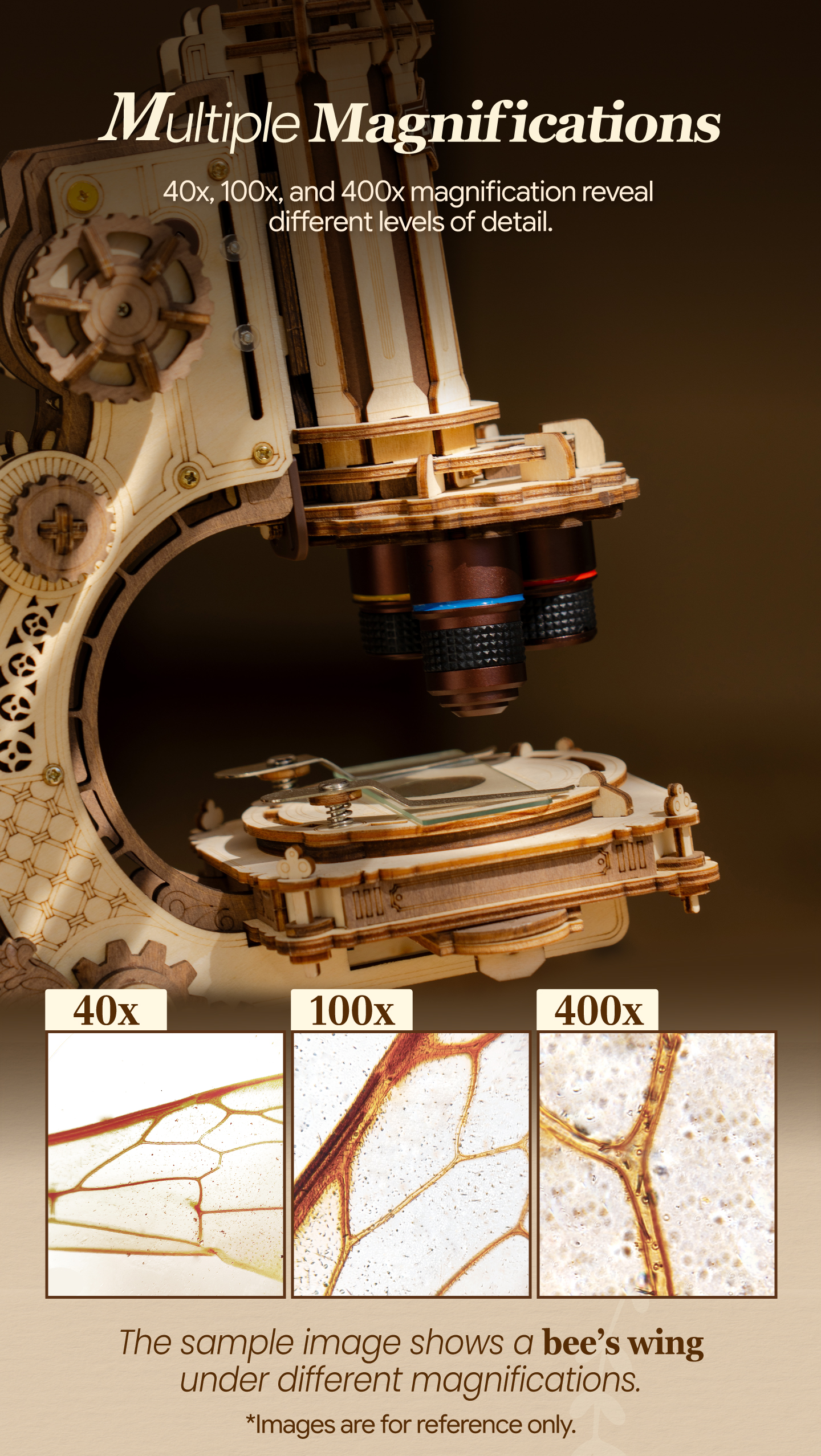
Engaging with these lenses and filters teaches STEM students:
- Total magnification. By switching lenses, students learn how the numbers combine, and how choosing a different lens is a tradeoff between a wider field of view for spotting layers and zooming in to catch finer details.
- Depth of focus. Adjusting the knob for higher zoom shows the sharp zone getting thinner just like how a photographer's camera lens would.
- Light and wavelength. With the help of different filter colors, details are isolated, and the resolution is sharpened.
Lessons in Mechanical Building
Assembling the model itself is a lesson in engineering discipline. Students learn sequencing, spatial reasoning, and the patience to troubleshoot rather than force wooden pieces into place. The assembly process activates critical thinking, spatial reasoning, and fine motor skills, while closely following instructions. The 4/6 star build difficulty also offers the right amount of challenge that's rewarding without becoming overwhelming.
As sections are completed, the builder discovers how these components work together to build a larger system, and that minute mistakes affect the model's operation. They learn to backtrack, correct, and redo, understanding why precision is valued in mechanical design. These concepts, planning, iteration, and attention to detail, are what real-world engineers do.
Lessons in The Scientific Method
Being a fully functional optical tool, the ROKR Microscope ST005 is ready for real specimens after assembly. Students become active researchers who execute investigations, formulate hypotheses, manipulate variables by switching lenses with different magnifications and colors, and observe results in real-time.
The excitement leads to discoveries in leaf cross-sections, fabric fibers, salt crystals, a drop of pond water, and everything in between. The ROKR Microscope keeps teaching indefinitely as learners continue to ask new questions.
Zooming in With Joyful Curiosity
The ROKR Microscope ST005 bridges the gap between theory and experience in a transformative way. It gives STEM learners a new perspective on everyday things, opening their world up to experiences that stay with them rather than merely theorizing.
More than just a display piece, this tool encourages curiosity, develops practical problem-solving skills, and shows that some of the best learning happens when you build something yourself.
Can you ask for more out of a back-to-school project?
Find more STEM-related models from ROKR's website.
-.jpeg?w=1080&h=607)