Wooden blocks and mechanical model kits may share the same natural material, but they are designed for very different stages of development. A young child benefits from large pieces that can become anything. An older builder may be ready to follow a sequence, fit precise parts together, and understand why a mechanism moves.
So, which is better? The short answer is that wooden blocks are usually the better choice for younger children, while structured building toys and mechanical model kits become more suitable as fine motor skills, patience, and safety awareness develop.
The right choice is not simply about age, however. Always check the manufacturer's age label, part size, required tools, assembly difficulty, and the individual builder's experience.
Quick Age Guide
| Age | Best Fit | What to Look For |
|---|---|---|
| 1–5 | Large-piece, open-ended wooden blocks | Lightweight pieces, rounded edges, simple shapes, and no small detachable parts |
| 6–9 | Simple structural building toys | Large connectors, short instructions, sturdy parts, and quick visible results |
| 10–13 | Basic model kits with adult supervision | A clearly matching age label, fewer parts, simple assembly steps, and no advanced tools |
| 14+ | Mechanical wooden models and complex assembly kits | Precise parts, gears or moving structures, multi-step instructions, and a meaningful challenge |
| Adults | Complex, functional, and collectible models | Longer builds, working mechanisms, sophisticated display value, and deeper engineering detail |
This is a practical starting point rather than permission to ignore the box.
Age labels come first: A kit marked 14+ is not automatically suitable for a younger child just because an adult is nearby.
What Is the Difference Between Wooden Blocks and Mechanical Model Kits?
Wooden blocks support open-ended play
Traditional wooden blocks do not have one correct finished result. A set of rectangles, arches, cylinders, and cubes can become a tower in the morning and a bridge in the afternoon. Children can stack, sort, balance, knock down, and rebuild without worrying about completing a fixed sequence.
That freedom makes blocks especially useful in the early years. The activity grows with the child: first comes grasping and stacking, then symmetry, pretend play, and more deliberate structures.
Mechanical model kits support goal-led building
A mechanical model kit starts with a defined outcome. The builder follows illustrated steps, identifies parts, fits them in the correct order, and gradually turns flat components into a vehicle, clock, music box, marble run, or other working display.
The appeal is not only the finished object. A good kit makes the building process part of the experience. Gears align, cranks transfer movement, tracks guide marbles, and structural pieces lock together. This calls for more precise hand control, longer attention, and the ability to recover calmly when a step needs to be checked again.
Ages 1–5: Choose Large, Open-Ended Wooden Blocks
For toddlers and preschoolers, simplicity is a strength. Large wooden blocks invite experimentation without requiring children to follow a diagram or handle delicate components. They can build at their own pace and enjoy an immediate result after placing only a few pieces.
Look for:
- Pieces that are too large to become a choking hazard
- Lightweight construction that is easy for small hands to lift
- Rounded, smooth edges
- Durable finishes intended for the stated age group
- Open-ended shapes rather than tiny connectors or decorative accessories
Small parts require particular care. The U.S. Consumer Product Safety Commission advises keeping toys with small parts away from children younger than three and following the age and safety information on the packaging. Its guidance also explains that products intended for children under three cannot contain or release prohibited small parts.
At this age, a complex wooden model is not a more educational version of a block set. It is simply the wrong type of challenge. ROKR mechanical kits contain precisely fitted components and are not positioned here as toddler toys.
Ages 6–9: Move Toward Simple Structural Building Toys
Children in this range can often move beyond free stacking and begin working toward a recognizable structure. The best transition is usually a simple building toy with larger parts, forgiving connections, and a short sequence of steps.
Suitable choices may include basic bridge-building sets, large interlocking construction pieces, simple vehicle frames, or beginner engineering toys designed and labeled for this age group. A child should be able to understand the next step, make progress without constant correction, and still have room to modify the finished structure through play.
Avoid choosing a kit only because the completed model looks exciting. A dense instruction book, fragile tabs, small gears, or long assembly time can turn curiosity into frustration. For ages 6–9, the build should feel clear and achievable before it feels intricate.
Ages 10–13: Try Basic Models With Adult Supervision
Preteens may be ready for a first model-building experience, especially if they already enjoy puzzles, construction toys, or craft projects. Start with a basic kit that has fewer parts, clear illustrations, and a difficulty level designed for beginners.
Adult supervision should be active rather than symbolic. An adult can help organize parts, read safety notes, check orientation before a piece is pressed into place, and step in if a component requires more force than expected. The goal is to support the process without taking over the entire build.
Most importantly, supervision does not replace the product's age recommendation. Choose only a kit whose label includes the child's age. Brand collections can span several age bands, so the exact product page and packaging matter more than the brand name alone.
For a first structured puzzle, compare beginner and advanced 3D wooden puzzles before choosing a longer or more precise build.
Ages 14+: Explore Mechanical Wooden Models and Complex Kits
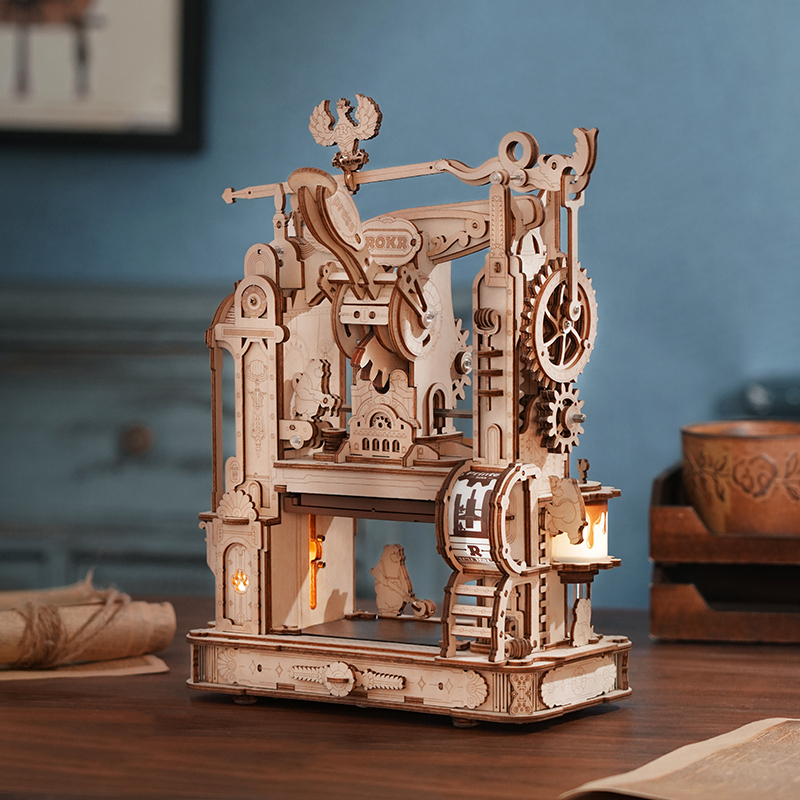
By the teen years, many builders are ready for projects that reward patience and precision. Mechanical wooden models add a satisfying layer to ordinary construction: the finished piece may reveal gear transmission, controlled movement, gravity, sound, or another functional principle.
This is where ROKR mechanical models become a natural option. ROKR focuses on mechanical 3D puzzles and models built around motion, structure, and hands-on assembly. Its official Mechanical Puzzle Series is recommended for ages 14 and up, making it a more appropriate match for teens than for young children.
A teen choosing a first mechanical kit should still compare:
- Difficulty level and number of pieces
- Estimated assembly time
- Type of mechanism
- Need for batteries, glue, tools, or other materials
- Finished function and display size
- Product-specific age and safety information
Someone new to model building may enjoy a shorter mechanism-led project before moving to a multi-hour marble run, clock, or complex kinetic model. The best first kit is not necessarily the simplest-looking object; it is the one whose instructions, time commitment, and mechanical challenge suit the builder.
Adults: Choose Complex, Functional, and Collectible Models
Adult model building is less about age eligibility and more about the experience a person wants. Some builders enjoy the concentration of a long, quiet assembly. Others want to understand how a historical machine works, operate a finished mechanism, or create a display piece that invites conversation.
For adults, the strongest options often combine three qualities:
- A substantial build: enough steps and precision to make the process absorbing.
- A functional result: gears, cranks, marble tracks, moving parts, music, or another confirmed mechanism.
- Collectible character: a finished model with a clear theme and lasting display value.
ROKR is especially relevant in this category because its range includes mechanical vehicles, artistic clocks, marble runs, music boxes, and kinetic creatures. Instead of choosing by age alone, adult builders can compare theme, difficulty, assembly time, mechanism, and the kind of object they want to keep on a shelf or desk.
How to Choose Between Blocks and a Model Kit
Ask these five questions before buying:
1. Does the product label match the builder's age?
Treat the printed recommendation as the first filter. Do not move a younger child into an older age category simply because the finished model appears educational.
2. Are the parts safe for the environment?
Consider younger siblings as well as the intended builder. A teen's model kit may contain small parts that should never be left within reach of a toddler.
3. Does the builder prefer invention or completion?
Choose blocks for open-ended experimentation. Choose a model kit for someone who enjoys instructions, sequence, precision, and a defined finished result.
4. Is the challenge motivating or overwhelming?
A useful challenge requires focus but still allows visible progress. If every step needs adult correction, the kit is probably too advanced.
5. What should happen after the build?
Blocks return to the box and become something new next time. Mechanical kits often become functional displays or collectibles. Both have lasting value, but in different ways.
Frequently Asked Questions
Are wooden blocks better than mechanical model kits?
Neither is universally better. Wooden blocks are generally better for younger children and open-ended play. Mechanical model kits are better for older builders who enjoy step-by-step construction, precision, mechanisms, and displayable results.
What age is best for mechanical model kits?
Complex mechanical wooden kits are generally most suitable from age 14 upward. Children ages 10–13 can try basic models with adult supervision only when the specific product is labeled for their age and matches their skill level.
Can a 10-year-old build a ROKR model?
Check the exact product rather than relying on the brand name. ROKR's catalog spans different age and difficulty filters, while its Mechanical Puzzle Series is recommended for ages 14+. If a product is labeled 14+, adult supervision does not change that recommendation.
Are mechanical model kits good for adults?
Yes. Complex kits can offer a focused hands-on project, an introduction to mechanical principles, and a functional or collectible finished display. Adults should compare difficulty, assembly time, mechanism, and theme rather than choosing only by piece count.
Final Recommendation
Choose the kind of building experience that fits the builder now:
- Ages 1–5: large, open-ended wooden blocks
- Ages 6–9: simple structural building toys
- Ages 10–13: basic age-labeled models with adult supervision
- Ages 14+: mechanical wooden models and more complex assembly kits
- Adults: complex, functional, and collectible models
Wooden blocks help young children discover what they can imagine. Mechanical model kits help older builders discover how carefully designed parts work together. When the age, safety requirements, and challenge level are right, both can turn a simple material into a rewarding hands-on experience.