
Most ROKR, Rolife, and Rowood kits are designed to snap together without glue, so adhesive works best as a backup, repair aid, or creative finishing tool.
Here’s the truth: most ROKR, Rolife, and Rowood kits are engineered to snap together without a single drop of glue. That’s part of the appeal of the snap-fit design.
But life happens: a piece snaps during assembly, you’re not happy with a part’s matte finish, or you simply want to reinforce your kit. It’s time for glue as a backup, repair kit, and creative tool in one.
Robotime spills the tea (or adhesive, ha!) on which glue actually does what, so you stop guessing and start building.
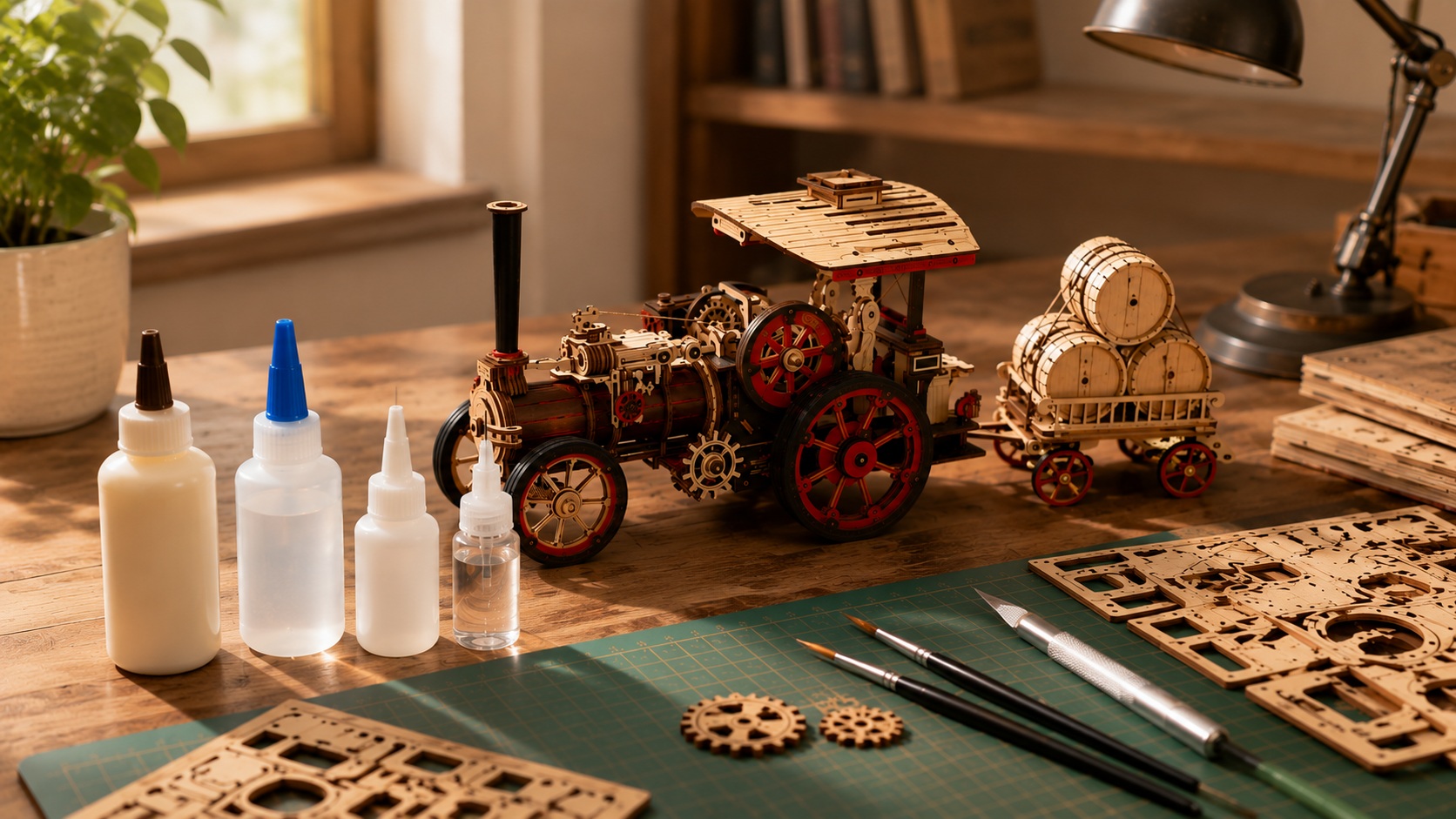
Tubes, Bottles, and What-Have-Yous
Here’s the rundown on adhesives you can use on your kits.
| Glue Type | Best Use | Set or Cure Time | Hold Style |
|---|---|---|---|
| PVA / tacky glue | General wood-to-wood bonds and paper, used lightly | 15 to 30 minutes to set; a full day to cure | Moderate strength; low flexibility; mostly permanent |
| Superglue | Small embellishments and fast repairs | Sets in seconds | Strong, brittle, permanent |
| Epoxy | Heavy-duty bonds, small gaps, and cracks | 5 minutes to 24 hours, depending on type | Strong, low flexibility, permanent |
| Hot glue | Quick fixes and temporary holds | Seconds to a minute | Low to moderate strength; brittle over time; semi-permanent |
| Wood glue | MDF boards, plywood, and structural wood joints | 5 to 10 minutes to set; full cure takes a day | High strength, low flexibility, permanent |
| Specialty adhesives | Clear plastic, fabric, props, plastic-to-plastic, UV effects, or mixed materials | Varies from instant hold to 1 to 2 days | Ranges from temporary wax to permanent flexible bonds |
PVA (Polyvinyl Acetate / Tacky Glue)
Examples: Aleene’s, Bearly Art, Scotch (3M), Anita’s, Art Glitter Glue
PVA is cheap, colorless, and forgiving for beginners. It soaks into porous wood fibers nicely, making it great for general wood-to-wood bonds. It’s not very water-resistant, though, and some variants are washable, though most cure permanently. The liquid version works on paper, too, but go easy on it, as too much moisture can cause paper to warp or wrinkle.
- Set and cure
- 15 to 30 minutes to set, a full day to cure
- Strength
- Moderate strength
- Flexibility
- Low flexibility once cured
- Hold
- Mostly permanent
Tip: Use a thin, even layer, don’t drown the joint. Best applied with a paintbrush for control.
Superglue (Cyanoacrylate)
Examples: Gorilla, Loctite, BSI (Bob Smith Industries), Starboard, Krazy Glue, Citadel, Army Painter
The instant gratification glue. This one bonds in seconds, holds strong, and shrugs off water and heat fairly well, though extreme heat can break it down over time. It’s great for small embellishments since you won’t need to clamp them. Be careful not to bond your fingers together, and use the gel variant if you don’t want runny superglue.
- Set and cure
- Sets in seconds
- Strength
- Strong
- Flexibility
- Brittle
- Hold
- Permanent
Tip: It fogs. Keep it away from clear plastic unless you want frosted windows.
Epoxy
Examples: Gorilla 5-Minute Epoxy, Loctite Epoxy, Devcon, Zap Z-Proxy, J-B Weld KwikWeld
The heavy-duty option. Strong, water- and heat-resistant, and capable of filling small gaps and cracks that other glues can’t. It comes in two parts that need mixing, and you’ll need to clamp parts while the adhesive cures.
- Set and cure
- 5 minutes to 24 hours setting time, depending on the type
- Strength
- Strong
- Flexibility
- Low flexibility
- Hold
- Permanent
Tip: Mix exact ratios. Eyeballing it is how you end up with a gummy mess that never fully hardens.
Hot Glue
Examples: Surebonder, Gorilla, AdTech, Dremel & Bosch
Fast, convenient, and instantly bonds. Unfortunately, it's not the most durable option; it creates noticeable bulk that can throw off careful alignment on small pieces. It also gets brittle with age, so it's better suited to quick fixes than anything permanent.
- Set and cure
- Seconds to a minute to set
- Strength
- Low to moderate strength
- Flexibility
- Becomes brittle over time
- Hold
- Semi-permanent
Tip: Great for temporary holds, not great if you want the bond to last.
Wood Glue (Aliphatic Resin / Carpenter's Glue)
Examples: Titebond, Gorilla, Elmer’s, FastCap 2P-10
Formulated specifically for wood fibers, this adhesive is more water-resistant than its cousin, PVA. It’s the go-to for MDF boards and plywood, and can bear actual structural weight.
- Set and cure
- 5 to 10 minutes to set, full cure takes a day
- Strength
- High strength for wood joints
- Flexibility
- Low flexibility once cured
- Hold
- Permanent
Tip: Clamp it while it dries for the strongest bond. Wood glue rewards patience.
Clear Silicone / Watch Crystal Cement
Examples: G-S Hypo, Rocket, Stella, Gorilla, Tamiya
This is the specialist of the group and built for transparent plastics for windows, mirrors, or anything where clarity matters. It’s your secret weapon for keeping see-through parts actually see-through.
- Set and cure
- Setting time varies by product
- Strength
- Moderate strength
- Flexibility
- Flexible
- Hold
- Semi-permanent to permanent hold
Tip: Use sparingly on edges only; a little goes a long way.
Pressure-Sensitive Adhesives (Sticky Wax / Museum Wax)
Examples: QuakeHold!, Ready America, Sara, TackyWax, Quake Wax, Blu-Tack
This adhesive is for the builder who wants items repositioned whenever the mood strikes. The wax never fully hardens, so it’s perfect for furniture or props inside a scene that you're not 100% committed to yet.
- Set and cure
- Adheres instantly, but not a true bond
- Strength
- Low strength
- Flexibility
- Very high flexibility
- Hold
- Temporary, fully reversible
Tip: Ideal for staging a scene before you commit to anything more permanent.

Plastic Cement (Poly Cement)
Examples: Tamiya, Mr. Cement, Testors, Revell, Plastruct
The hobbyist's not-so-secret weapon. It doesn't show up high on this list often because most kits don't call for it, but when you're bonding two plastic pieces together, nothing else compares. Rather than sitting between the pieces like glue, it actually melts the plastic surfaces slightly so they fuse, welding them together with zero bulk.
- Set and cure
- Sets quickly, fully cures within hours
- Strength
- Strong, seamless bond
- Flexibility
- Low flexibility
- Hold
- Permanent
Tip: Work in a ventilated space and double-check the cement is rated for your plastic type before applying.
Ventilation and material compatibility matter. For strong fumes or solvent-based adhesives like plastic cement, crack a window open and test compatibility before applying glue to a finished kit part.
UV Resin / UV Glue
Examples: JDiction, Let’s Resin, Green Stuff World, Sophie & Toffee
If you like magic tricks, this glue’s for you. It stays liquid until hit with UV light, at which point it cures in under a minute. Great for faking water effects, and you can mix in color for a tinted liquid look, which makes it incredibly handy for any scene involving ponds, rivers, or that one suspiciously realistic drink or puddle.
- Set and cure
- Sets in under a minute, but only once exposed to UV light
- Strength
- Moderate to high strength
- Flexibility
- Moderate flexibility
- Hold
- Permanent
Tip: Keep it out of direct sunlight while working, or it'll cure before you're ready.
Fabric Glue
Examples: Aleene’s, Tear Mender, Beacon Fabri-Tac, Gutermann, Dritz Liquid Stitch
Built for leather and textile pieces like tiny beddings or curtains. It lets fabric keep moving and draping naturally instead of turning stiff and crackly. It’s washable, flexible, and won't bleed through the material.
- Set and cure
- Sets in 3 to 10 minutes, fully cures in 1 to 2 days
- Strength
- Moderate strength
- Flexibility
- Flexible
- Hold
- Semi-permanent, washable
Tip: Apply thinly along edges only to keep the fabric's natural drape intact.
Alphanumeric Specialty Glues
Examples: B-7000, E6000
The overachiever of this list. Originally designed for smartphone screen repairs, it's become a book nook favorite for good reason. It dries crystal clear, stays rubbery and flexible even after curing, and bonds wildly different materials together, including wood-to-plastic, fabric-to-metal, you name it. Of the brands on the market, only the B-7000 has a built-in metal needle tip that prevents clogging between uses.
- Set and cure
- 3 to 5 minutes to set
- Strength
- Strong
- Flexibility
- Very high flexibility, stays rubbery
- Hold
- Permanent
Tip: Don't over-apply as heavy layers can warp delicate materials, especially paper or acrylic sheets.
Before You Go
- Clean as you go. Wipe excess glue immediately. Dried glue is a much bigger headache than wet glue.
- Match the viscosity to the job. Runny glue on a vertical surface is just gravity's way of laughing at you.
- Control your application. For tiny, precise drops, dip a toothpick into the glue rather than squeezing straight from the bottle. For flat surfaces, spread evenly with a card or thin paintbrush. Whenever a kit comes with its own applicator, use it, as it was designed for that exact job.
- Test before committing. Try the glue on a scrap piece first, and always dry-fit your parts before adding any adhesive. There's no undo button once most of these set.
- Ventilate your space. Most glues on this list release fumes, some more aggressively than others (looking at you, plastic cement). Crack a window open.
Armed with this list, you should never have to guess your way through the glue aisle again. Pick the right one, apply it with a little patience, and your wooden 3D puzzle or miniature kit will thank you for it.
Quick FAQ
Do ROKR kits need glue?
Most ROKR, Rolife, and Rowood kits are engineered to snap together without glue, but adhesive can help with repairs, reinforcement, finishing, or creative details.
Which glue is best for clear plastic parts?
Clear silicone or watch crystal cement is the specialist choice for windows, mirrors, and transparent plastics where clarity matters.
What should I do before applying glue?
Dry-fit the parts first, test the glue on a scrap piece, control the application, and ventilate your workspace.