
We absolutely dig the game: the plunger release, the ball bumping, the flipper feedback, the flashing lights, the high-score chase, the anticipation, the reactions. Sometimes, it’s all we need to beat some stress and boredom.
Sometimes, it’s all we need, period. Ha!
But have we ever stopped to wonder how all the game’s components work, and why they work that way?
Let’s go geek mode today to explore the physics of the pinball machine and what makes the game so exciting.
Bouncing Off the Bagatelle
Ever heard of bagatelle? No, it’s not food, but it is French. This game was played centuries ago, when a player used a cue stick to shoot small balls up a sloped board studded with pins and scoring pockets. It’s sort of like pool or billiards, but with obstacles. Players waited as gravity took over, hoping for a high score wherever the ball happened to land. Those pins helped give pinball its name, but this early tabletop game was still a bit far from the version we have today.
Enter the 20th century, where the coin-operated iteration introduced the spring-loaded plunger launch. Exciting? Not quite. The ball was still just falling wherever gravity and the pins sent it, which left player success to luck and chance.
The pivotal flippers made the game more interactive in 1947 when the company Gottlieb introduced them. Now, players had more control in what was known as the Humpty Dumpty, an electro-mechanical pinball machine that featured six flippers. The big shift? Well, if you lost, it was now a skill issue.
Soon after, active pop bumpers sped up the game, and then more and more improvements, like elaborate ramps and multi-ball play, upped the chaos, until it evolved into the pinball we enjoy today.
Let’s inspect these innovations, and what better place to start than the plunger?
Coil Like a Cat
When you pull back the pinball’s knob, you feel a resistance build. That’s the spring storing elastic potential energy as it compresses. The farther you pull it back, the greater the spring force; the stored energy rises with the square of the compression. Release it, and some of that energy becomes the ball’s motion.
Think of it like a cat before it jumps a six-foot wall: the deeper the crouch, the more force stored up, and the farther it leaps the instant that tension releases. But without the smug feline smile, of course.
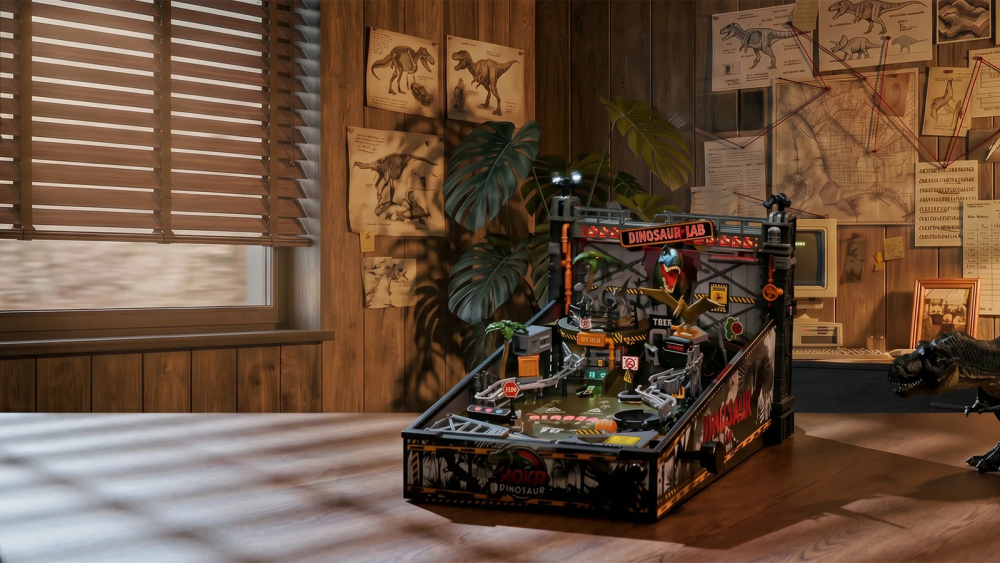
On ROKR’s Dinosaur Lab Pinball Machine (MGP01), the plunger spring slides over a fixed post. The assembly guide shows how to fit and tension the mechanism with an Allen key; follow the kit manual for the correct adjustment. Too little tension can turn a satisfying launch into a disappointing nudge, like the cat basically attacking the wall with its face.
Flip It to Win It
Do you remember learning about simple machines back in grade school? The pinball’s flipper is actually a basic lever-and-pivot system, just built to swing fast enough to send a steel ball flying.
Getting the physics right is harder than it looks. The flipper arm rotates around a fixed pivot point, and a return spring pulls it back to resting position the instant you release it. The speed and force the ball leaves with depend a lot on how fast that arm can rotate and how directly it transfers momentum into the ball at the moment of contact. Flipper geometry, or how long the arm is and where exactly the pivot sits, must be done right so that it reacts instantaneously when you push that button to hurl the ball back into play. Too much resistance and you lose force, making the flipper action weak or late.
So now let’s address the cat, er, elephant in the room. The MGP01’s flippers are a place for builders to be especially careful. Its assembly guide calls for grease at the moving metal-and-plastic pivot contact to reduce friction. Skip that step, and you may lose some of the force before it reaches the ball.
Then there’s the retaining screw, which wants to be snug, not WWE-death-grip tight: overtighten it and you risk damaging the plastic around the pivot. It’s a neat, physical lesson in friction and tolerance: sometimes the most powerful move is knowing when to stop turning the screwdriver.
Ramps and Lanes: Gravity Still Has Its Say
Onto the next level, literally, with ramps and lanes. Once the ball’s in play, these deliberately designed paths put inclined-plane physics to work: climbing converts some of the ball’s kinetic energy into gravitational potential energy, and descending converts some of it back. A steeper climb needs more energy; on the way down, the ball can gain speed, though friction and collisions also matter.
Game designers know this; that’s why they choose ramp angles and shapes to take advantage of gravity’s downward pull and keep the game going.
On ROKR’s MGP01, the ball has to pass cleanly through ramps and lanes. That’s clearance and curve geometry in practice: give a rolling ball enough room and a smooth path, and momentum carries it onward. If a path is pinched too tight or misaligned, the ball can jam instead.
Bumping into Isaac
Eyy, ‘sup Newton? Hope you don’t mind, but we’ll be exploiting your third law now with all the bumping and ricocheting a pinball table can throw at it. Appreciate it, man.
This is where those springy, tiny bumpers, well, bump the game several notches higher. In every collision, the ball and bumper push on each other with equal and opposite forces: that’s Newton’s third law. A powered bumper can also add energy from its mechanism, sending the ball away faster than a passive post would. The extra kick does not make the paired forces unequal.
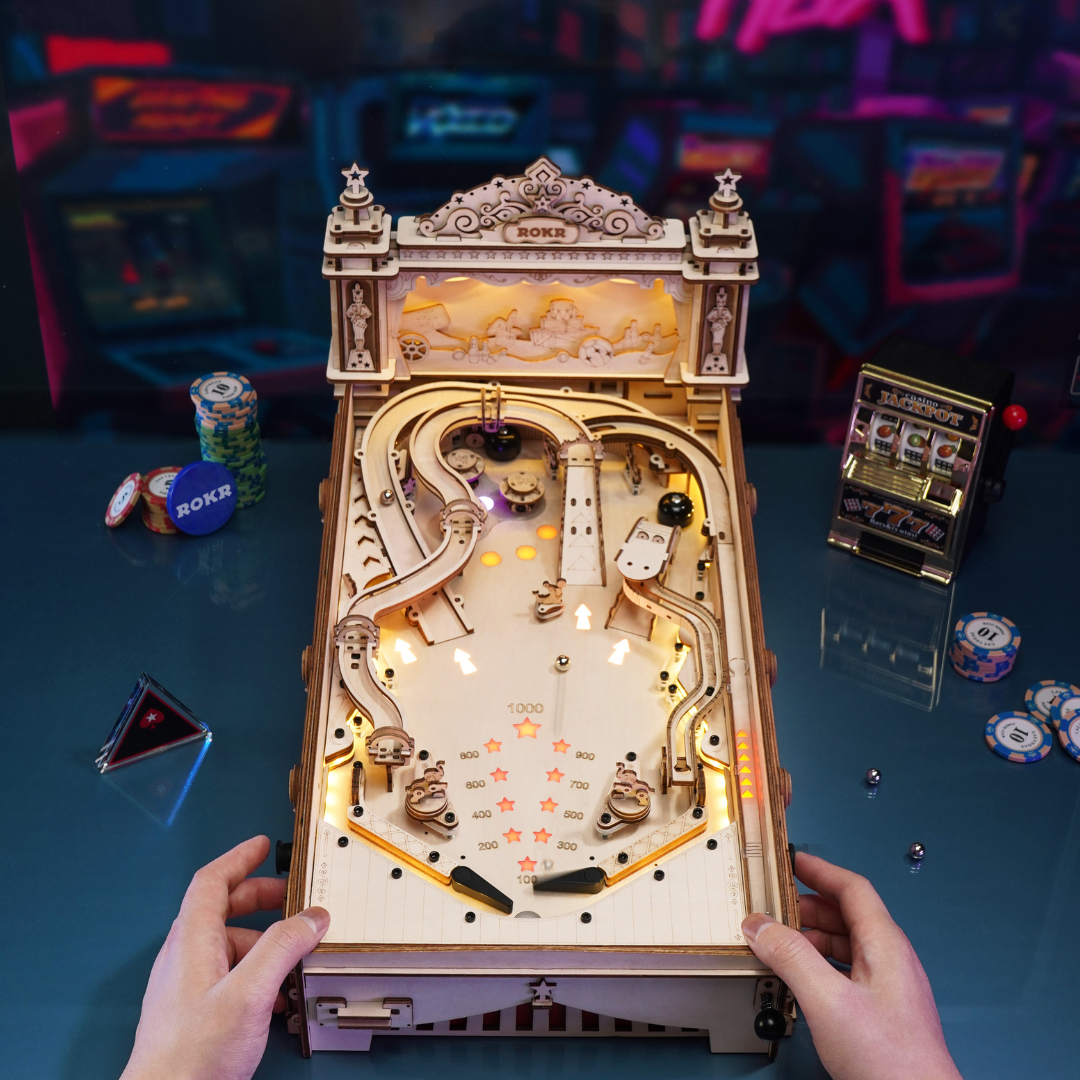
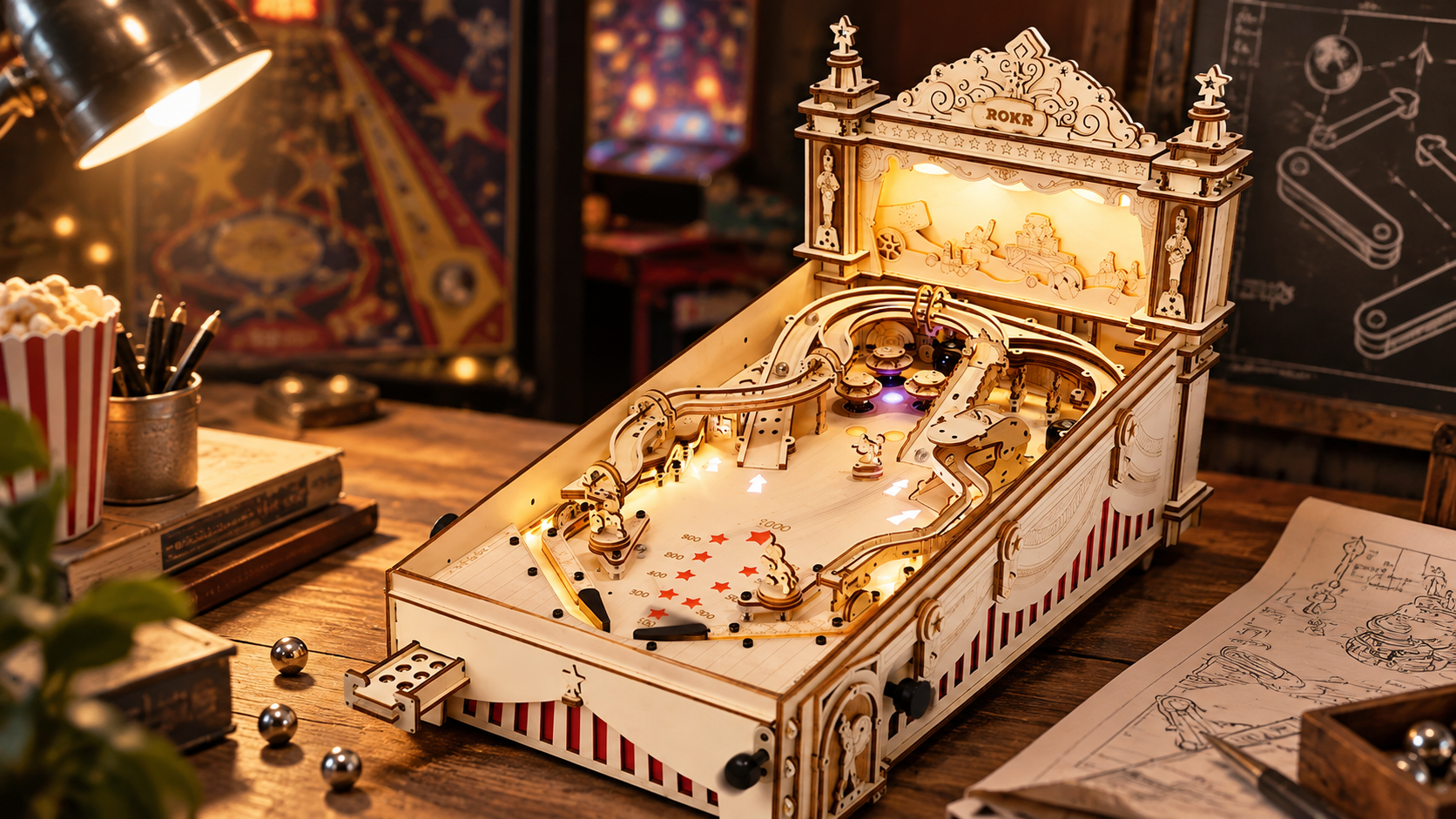
Remember ROKR’s OG, rather EG01? That circus-themed 3D Pinball Machine uses bumpers and targets to keep the ball moving through its mechanical playfield. It offers a useful contrast with the MGP01’s more active bumper action.
On the other hand, the MGP01 takes a more active approach with its solenoid bumper. The build includes a conductive contact ring and a wired solenoid mechanism; when triggered, the bumper physically kicks the ball back into play. That active hit is why the feature stands out to early builders. Fistbump, yeah!
What’s the Score?
No, really, what’s the reading on the scoreboard? Pinball machines register where the ball has been using a mix of switches and sensors. Some designs use light-based sensors at particular lanes or targets; others use mechanical contacts. Either way, the game translates a detected hit or pass into a scoring event.
Here’s one trick: when a ball rolls through an optical sensor’s path, it interrupts a beam of light. That signal can tell the machine the ball passed a particular point while you’re busy yelling at the flippers.
An optical sensor has no ball-actuated mechanical contact at that location, so there is no switch leaf there for the ball to press or wear. But that does not mean a whole pinball machine is switch-free: many playfields use both optical sensors and physical switches.
And here’s the literal bonus on the MGP01: scoring does not stop at “ball touched thing, point earned.” Its targets and mission-based play give players more to aim for than a flat score counter. That’s part of what turns pinball players into high-score hunters.
Game Over = Just Getting Started
Behind every pinball machine is the physics that makes us obsessed with it. Springs, levers, inclines, collisions, and sensors all conspire to make you demand one more game instantly after the last one ends.
Explore the other side of the same machine by building a ROKR pinball kit yourself. The EG01 and MGP01 let you feel a spring resist under your fingers, work a flipper, and watch a bumper send the ball back into play. Building the mechanism can also deepen your appreciation of how the game developed from bagatelle to now.
Pinball isn't chaos. Truth is, it’s just physics wearing a really good disguise, dinosaurs escaping research facilities and all.